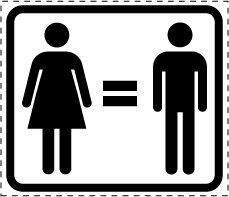
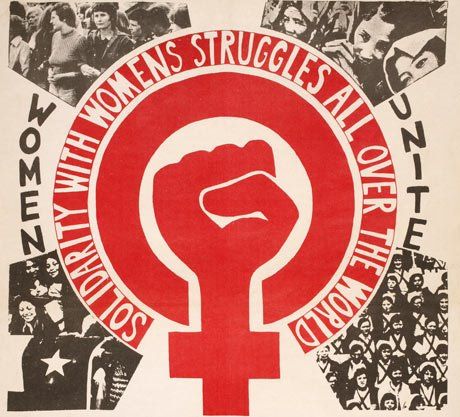
Women Need Men to Achieve Equality


Slaves of all races needed and still need free people to fight with them to defeat slavery.
Blacks needed whites to stand in solidarity in order to roll back Apartheid and the Jim Crow laws.
The GLBTQI community  needs members of the heterosexual community to come along side them to find acceptance.
Jews needed Gentiles to stop the madness of Auschwitz and defeat the Third Reich.
Women need men to achieve equality in the church, in the home, in government and in the workforce.

The minority always needs at least a few members of the majority to stand in their corner and advocate on their behalf for the status quo to be challenged and for things to change.

The persecuted, the excluded, the oppressed, the enslaved, the unclean, the deformed and the sinners needed someone to tear down the wall that separated. (That is all of us)

The women, the men, the Jews, the Gentiles, the slaves, the free needed someone to tear down the dividing wall that separated them from each other.

Jesus is the obliterator of all that separated and separates us still. He came to rip it in half and to tear it down.

Today an amazing blog from J. R. Daniel Kirk a Professor of New Testament at Fuller Theological Seminary came to my attention. It is called A Time to Speak. It is specifically about the issue of women in the church however the truths in it can be applied to more than just this issue.

Dear men, it is not enough to be supportive in your hearts. If your church is excluding women from service, you need to be creating opportunities to overturn that practice.
You need to speak. You need to ask.
Dear pastor, it is not enough to huddle with your buddies over beer or in your internet discussion room and talk about what a bunch of sexist bastards your fellow pastors are in your denomination.
If you are not working to change what women can do, you are promoting and sustaining the sexism that you deride in private.
If you are not opening up space in your church for women to preach and teach, you are promoting and sustaining the sexism that denies the truth of your women’s identity in Christ.
Dear seminary professor, your job is to be a change agent. Your job is to transform the way that your students, and their churches, think about and act on issues of gender.
It’s not enough to “know” that women should be able to do anything. You need to show your students, from your scripture study or theology, that this is God’s intention for the church.

This applies to all of us. If there is something you believe in, if there is an area where you know you should be speaking on behalf of the oppressed or excluded and you keep silent you are in effect promoting and sustaining that which you know is wrong. If you fail to speak up when your friend calls something or someone “gay” or you don’t come to the defense of a female coworker when she is called a bitch for being a strong leader, if you stand by when girls and women are silenced and discounted in the name of Jesus you participate and condone the very thing you disagree with in your heart. I believe this is what the Scriptures are talking about when they say a double-minded person is unstable in all their ways. When we will not stand up for our convictions we waver in our faith and become double minded.

He wraps up the post with this call to action:

We must create the kind of church that will receive not just our sons but our daughters, not just our brothers but our sisters, in the fullness of who God is making them to be, in Christ, by the Spirit.

If you believe in women’s equality, your calling is to act it out. If you’re not, don’t convince yourself that you’re being “wise” in biding your time while your sisters suffer. Wisdom is a convenient cover for fear, but not all silence is golden.

I for one have decided not to remain silent anymore. This blog is my attempt to speak into the world a message of love and acceptance, freedom and hope. The Kingdom of Heaven is at hand and the gates have been flung wide

Gendered Virtue or Is This Bench Taken?


Are there virtues exclusive to women?
Are there virtues which should be exclusive to women?
Don’t the scriptures make a listing of what it is to be virtuous?

This week I was prompted to read a blog entitled “Militant Virtue” by Rachel Janovic at the Femina blog. Rachel makes all sorts of assertions in her post about “female virtues” and how we as women should have an “active defense” against men who would “leave a mark” on us (yes, like a dog marks its territory).

Sigh.

First let us look at the definition of the word virtue. Dictionary.com defines virtue as:

vir·tue [vur-choo]

noun

1. moral excellence; goodness; righteousness.
2. conformity of one’s life and conduct to moral and ethical principles; uprightness; rectitude.
3. chastity; virginity: to lose one’s virtue.
4. a particular moral excellence. Compare cardinal virtues, natural virtue, theological virtue.

5. a good or admirable quality or property: the virtue of knowing one’s weaknesses.

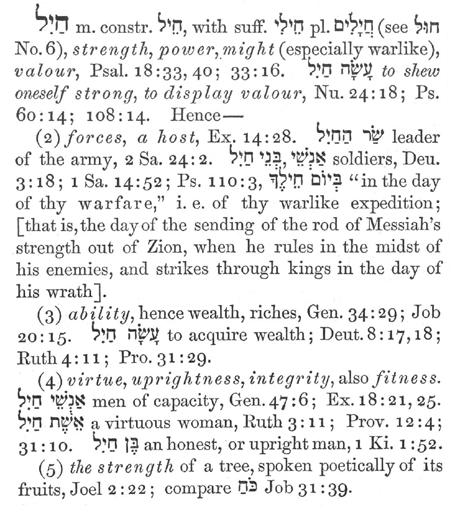
The word virtue is not used in the Old Testament rather, the word virtuous is. The word for virtuous in Hebrew is chayil (which you will recognize if you have been following this blog for long).
Chayil is defined by Thayer’s Lexicon (Strongs #2428) as:


Did you catch that? Chayil is used 243 times and translated:

  • army
  • man of valor
  • host
  • forces
  • valiant
  • strength
  • riches
  • wealth
  • power
  • substance
  • might
  • strong

Chayil is used 3 times specifically of a woman or women.
Ruth 3:11  – And now, my daughter, do not fear. I will do for you all that you ask, for all my fellow townsmen know that you are a worthy woman.
Proverbs 12:4 – An excellent wife is the crown of her husband, but she who brings shame is like rottenness in his bones.
Proverbs 31:10 – An excellent wife who can find? She is far more precious than jewels.

We have been through this before, but the Proverbs 31 list is not viewed in the Jewish tradition as a list of things all good wives (read “women of virtue”) must live up to. But rather it is a listing of examples of ways that women can show their Chayil. Just a bonus, if you read Proverbs 31 and compare it to the list above these are all different ways women can show valor or virtue. I will assert here again that there are as many ways to be an excellent wife as there are women. I would also assert that even these examples of virtue can have application to men as well. Could you not (gasp) reverse the genders in the Proverbs verses and still have truth? Let’s try it and see…

An excellent husband is the crown of his wife, but he who brings shame is like rottenness in her bones.
An excellent husband who can find? He is far more precious than jewels.

I know my excellent husband is like a crown to me. I am a very blessed woman. And I know plenty of women who can attest that a man who behaves shamefully is “like rottenness to her bones”.
Second one, once again, true. As the saying goes, “a good man is hard to find” and honey if you find one as good as mine you better hang on to him tight! He is more precious than a big ass engagement ring.

Okay, for grins, now let’s look at the word virtue in the new testament and see what it has to say. The word for virtue in the new testament is Dynamis. Dynamis is defined by Thayer’s as:


Dynamis is used 120 times and translated the following ways:

  • power
  • mighty work
  • strength
  • miracle
  • might
  • virtue
  • mighty

Dynamis is never used to exclusively describe men or women but rather God, Jesus, the Holy Spirit, the Kingdom, miracles and even the strength of sin.

Ok, enough background (sorry about the length of this post but I felt like proper background was needed), on to the article. Ms. Janovic lists what she considers to be “female virtues” at the beginning of her post: gentle and quiet spirit, modesty, chastity, faithfulness at home. She states that, “Scripture does not define virtues in terms of empty space; it is defined in terms of fruit.” First of all I feel compelled to point out that I am unable to find a verse in the Bible that defines virtue in terms of fruit. I am also unable to see where virtue is delineated along gender specific lines. I do see in Galatians where it lists the fruit of the spirit for both men and women.  I do see in scripture where it says that in Christ there is no male or female.

It would seem that the author subscribes to the gendered virtue model embraced by Rousseau. This model asserts that there are special virtues characteristic of each and arising out of their different basic natures. This model is extra biblical. P.J. Ivanhoe of the University of Michigan summed it up this way in his paper Women and Virtue,

In his work Emile, he describes the ideal education that a young man should receive, an education that will develop the set of virtues that are the full manifestation of his manly nature. In this same book, though not occupying as important a position, is a description of the proper education Emile’s sister, Sophie is to receive. It too is described in terms of developing virtues that fully manifest her basic nature. But while Emile’s virtues concern life in the public realm of a citizen, Sophie’s virtues concern life in the private realm of the home. According to Rousseau, women not only have special virtues that are theirs alone, they lack many virtues that are seen as exclusively male. And virtues that women are thought to lack are those required for public, political life – the realm of a great deal of power.

Ms. Janovic or other Christians I know who take her positions in this article might say they disagree with my characterization, however I think her post belies that assertion. First of all her use of the Fairie Queene as an illustration points directly to the division of the virtues into masculine and feminine. Chastity in this story is represented as a female Knight or female virtue. As she says, a “militant virtue” that “requires an active defense”.

What happens next and throughout the article I find patently offensive. She decides to use the imagery of men as dogs who simply go about “marking their territory”. She states:

“…if you have ever watched a nature film, or seen a dog on a walk, or really paid attention to life at all, you will have noticed a certain tendency among the male of the species. They mark their territory. They make a claim. They fight over the girl water buffaloes. Men do exactly the same thing, starting somewhere around the sixth grade. They like to impose on women around them in a way that builds their territory, or their prestige, or their ego.”

So guys, here it is, you are nothing but a beast who cannot be trusted to control himself when wanting to…
wait for it…
wait for it…
SIT NEXT TO A GIRL ON A BENCH IN A PUBLIC PLACE!
ASK A GIRL FOR A RIDE!
HAVE AN INSIDE JOKE WITH A FRIEND WHO HAPPENS TO BE A GIRL!
TEXTING HER TOO LATE

But it is ok, “it is not necessarily springing from any deep nefarious desires. Sometimes, it is just an accident. Sometimes it is a bad habit, or a different culture. Sometimes they aren’t actually paying attention when they impose. So don’t take this post as an accusation towards the men who impose on, or attempt to impose on you. These are all excellent opportunities for you to practice virtue.”
You see, you don’t even know you are being inappropriate, you are simply clueless. But that is ok too because it is all the woman’s responsibility to have a strong defense! She must not allow herself to “be imposed upon”. She should not “just let these things happen.” It is her fault if she stays on the bench when you sit down to chat. “Simply not resisting is how [she lets]a mark be made.”

Of course it is also her responsibility not to be shrill. According to the author, “Young women have a great deal of trouble with the fear of being shrill, and if that doesn’t scare them they probably are shrill.” So ladies, it is also your job not  to”overreact, but to be perfectly firm and cheerful. Someone unwelcome joins you on a bench? Unjoin him. Stand up. Walk away.”

The author also appears to think the women are clueless. She writes:

I know another problem for the unmarried women is that they might think that the young man, or young men, are all interested in them seriously. They feel like these things would not be happening in Christian circles if the men involved had no intentions. They would not be getting rides with me, walking me to my car, making a show of having inside jokes with me, or otherwise giving me attention if they were not actually interested in me.

Perhaps *gasp* the man and the woman are JUST FRIENDS! Perhaps they just want to get to know each other.

In the end her advice is this:

So if you are a young woman in this kind of situation, practice cheerful resistance. If the world of interaction between the sexes was a billiard table, be a bumper, not a pocket. Cheerfully, firmly, rudely  enforce your standards. You don’t owe him an explanation. Don’t get caught up in reasons you can’t give him a ride. Just say no. If he insists, pushes, tries harder, say, “Have a nice walk!”
Do not be afraid that this kind of defense will keep anyone from ever seriously being interested in you. If it is the right kind of man, this sort of behavior will bless him deeply.

Again guys, if this kind of behavior is off putting to you, if you think that when you sit down to chat with a girl on a bench and she gets up and walks away that she isn’t interested, you just aren’t the “right kind of man.”

The War on Women is NOT limited to Republicans

In the past week alone…

  • Hilary Rosen, a DNC consultant, has insulted stay at home mothers everywhere by saying women like Ann Romney have “never worked a day” in their lives.
  • We have learned that women in the Obama White House are earning 18% less than their male counterparts while President Obama travels around the country condemning this very problem.
  • The Republican Governor of Wisconsin repealed the state’s Equal Pay law. Republican state senator Glenn Grothman, who was an enthusiastic fan of repealing the law, actually said,
    • “You could argue that money is more important for men.” and “I think a guy in their first job, maybe because they expect to be a breadwinner someday, may be a little more money-conscious. To attribute everything to a so-called bias in the workplace is just not true.”
  • John Piper , influential pastor and author, posted, “When the Titanic sank 20% of the men and 74% of the women survived. That profound virtue was not nurtured by egalitarianism.”
  • Of the 740,000 jobs lost since president Obama took office, women accounted for 683,000 of those jobs.
  • Ashley Juddhad took to the internet to decry the morbid fascination people have with women’s appearances and the glee they seem to have in picking them apart (especially other women). She wrote,
    • Patriarchy is not men. Patriarchy is a system in which both women and men participate. It privileges, inter alia, the interests of boys and men over the bodily integrity, autonomy, and dignity of girls and women. It is subtle, insidious, and never more dangerous than when women passionately deny that they themselves are engaging in it. This abnormal obsession with women’s faces and bodies has become so normal that we (I include myself at times—I absolutely fall for it still) have internalized patriarchy almost seamlessly. We are unable at times to identify ourselves as our own denigrating abusers, or as abusing other girls and women.”

The “war on women” is not a war waged by Democrats vs. Republicans; Men vs. Women or Christian vs Atheist. It is not a war of gender or a war of politics. It is a war of ideas.  It must be turned into a war, not on women but a war on patriarchy. According to dictionary.com:

pa·tri·arch·y [pey-tree-ahr-kee]

noun, plural pa·tri·arch·ies.

1. a form of social organization in which the father is the supreme authority in the family, clan, or tribe and descent is reckoned in the male line, with the children belonging to the father’s clan or tribe.

2. a society, community, or country based on this social organization.

As Ashley Judd so eloquently said, “Patriarchy is not men. Patriarchy is a system in which both women and men participate.” I know plenty of men who, armed with love, education and justice wage war against patriarchy. I also know all too many women who defend patriarchy even when it means the subjugation and abuse of themselves, their daughters and other women.
I know many, many patriarchalists, some of whom believe with all their hearts that it is the answer to all of societies ills and for whom if they were honest would admit that they would prefer it if we could roll the clocks back to when women occupied the private sphere and men the public. I do not doubt their sincerity, I do however disagree with them vehemently on the roles of women in the family, in society, in the workplace, in politics, in church and in every arena.

God and Homsexuality: Part 4 – “Eunuchs Who Have Been So From Birth” Matt 19

* WARNING* Today’s post is rather lengthy but, in my defense…it needed to be. 😉

Another week has gone by and it is time to discuss another passage from the scriptures that relates to homosexuality. Today I want to cover Matthew 19:3-12 mainly because of the discussion about whether or not people are born homosexual as well as whether it is “natural” or against nature. it is vital to have this discussion as we move into the New Testament verses regarding same sex relations.

And Pharisees came up to him and tested him by asking, “Is it lawful to divorce one’s wife for any cause?” He answered, “Have you not read that he who created them from the beginning made them male and female, and said, ‘Therefore a man shall leave his father and his mother and hold fast to his wife, and the two shall become one flesh’? So they are no longer two but one flesh. What therefore God has joined together, let not man separate.” They said to him, “Why then did Moses command one to give a certificate of divorce and to send her away?” He said to them, “Because of your hardness of heart Moses allowed you to divorce your wives, but from the beginning it was not so. And I say to you: whoever divorces his wife, except for sexual immorality, and marries another, commits adultery.”

The disciples said to him, “If such is the case of a man with his wife, it is better not to marry.” But he said to them, “Not everyone can receive this saying, but only those to whom it is given. For there are eunuchs who have been so from birth, and there are eunuchs who have been made eunuchs by men, and there are eunuchs who have made themselves eunuchs for the sake of the kingdom of heaven. Let the one who is able to receive this receive it.”

The context of this section is marriage and divorce, let’s start with that. Jesus is approached by the Pharisees about whether or not the divorce practices of the day were lawful. Jesus answers  by telling them what God said to Adam and Eve. The Pharisees are unsatisfied with this answer and say, “But what about Moses?”  Jesus tells them that the law of Moses in regard to divorce were given because of the hardness of people’s hearts not because God wanted people to get divorced. Jesus has in essence brought marriage back to before the law and said the ideal is for people to get married, become one and not to separate and return to the homes of their families. Once again, Jesus makes it about the law of love.

Now the disciples decide to get involved in the conversation, they say, “If such is the case of a man with his wife, it is better not to marry.” What comes next has always seemed really odd to me. Jesus starts talking about eunuchs! What do eunuchs have to do with it? Is Jesus just changing the subject or what? No, he isn’t changing the subject he is just expanding it to include the sexual minorities of the day. This appears to be a list of the people who should not marry members of the opposite sex. So the disciples say to Jesus, “this is hard, maybe its better for men and women not to get married” and Jesus says, “No, this is hard but the reason not to marry isn’t because it is difficult but rather is because of: how one was born, something that was done to them, or their choice not to marry for the sake of the Kingdom.”  These three groups are listed as: #1. “eunuchs who have been so from birth”, #2. “eunuchs who have been made eunuchs by men” and #3. “eunuchs who have made themselves eunuchs for the sake of the kingdom of heaven”.

Ok, now let’s address these three groups in reverse order.
#3. “eunuchs who have made themselves eunuchs for the sake of the kingdom of heaven” – This phrase is also translated as, “others have renounced marriage because of the kingdom of heaven”, “some choose not to marry for the sake of the Kingdom of Heaven”, and “others have decided to be celibate because of the kingdom of heaven”. It seems clear that these are people who have decided to abstain from sex with women for the sake of the Kingdom.

#2. “eunuchs who have been made eunuchs by men” – This phrase referred to castrated males. This was a very common practice and was frequently done “early enough in his life for this change to have major hormonal consequences” and was “carried out on the soon-to-be eunuch without his consent in order that he might perform a specific social function.”

#1. “eunuchs who have been so from birth” –  AHA!!! Now we get to brass tacks! What exactly does this mean? Some say it means that Jesus is acknowledging that men can be born homosexual and some say that Jesus is merely referring to people who are born without testicles or who are impotent.

According to the Brown, Driver, Briggs, Gesenius Hebrew Lexicon, the Hebrew word for eunuch is saris and its derivatives. Saris is believed to be an Assyrian loan word. A secondary meaning of saris, from the Hebrew, is to castrate but Jesus speaks with divine authority when He teaches that not all eunuchs are castrated, Matthew 19:12. According to Jesus, some eunuchs are born that way, in distinction from a man who has been physically castrated.

Prominent evangelical professor, Dr. Robert Gagnon who believes all homosexual practice is sinful, put it this way,

Probably “born eunuchs” in the ancient world did include people homosexually inclined, which incidentally puts to the lie the oft-repeated claim that the ancient world could not even conceive of persons that were congenitally influenced toward exclusive same-sex attractions…

John J. McNeil, is a Jesuit Priest and also earned his PhD in Philosophy from Louvain University in Belgium asserts,

The first category, those born as eunuchs, is the closest description we have in the bible of what we understand today as a person with a homosexual orientation.

In the book, Jesus, the Bible, and Homosexuality, Jack Rogers makes some very insightful points about this passage.

Many commentaries focus on the discussion about divorce and miss the larger point of the passage. But look carefully: Jesus is asked a question about heterosexual marriage and divorce and immediately broadens the conversation to acknowledge three different types of sexual minorities in that culture…That is stunning, especially given that “the eunuch was persona non grata both socially and religiously” in that culture.

It is clear that Jesus did not see humanity as universally heterosexual.  Jesus recognized and acknowledged many types of sexual difference–even in a society in which such difference would have been downplayed, hidden, or even punished.

…the text which immediately precedes Jesus’ discussion of eunuchs, Jesus stands up for women. As Boheche observes, “Jesus counsels mutuality between husband and wife, rather than affirming the traditional laws of divorce which favored the husband.” And in the text which immediately follows our text, Jesus blesses the little children, another group who would have been largely ignored at the time.

Rogers also ties this passage to the story of Philip and Ethopian eunuch. He makes several good points here as well. First that an “angel of the Lord” directed Phillip to go down the road that led him to the encounter. Then the Holy Spirit directed him again to, “Go over to the chariot and join it.” He goes on to point out that this eunuch was the first Gentile to be baptized, and he was not just a Gentile but was a foreigner of a different race and ethnicity who also belonged to a sexual minority who was not fully welcome in the worship community. His baptism signaled a seismic shift in who was allowed to be a part of God’s Kingdom (The True Magic Kingdom).

It is also significant that the Eunuch was reading from the book of Isaiah. Theodore Jennings Jr., professor of biblical and constructive theology at Chicago Theological Seminary, discusses this fact extensively. He makes the point, “The Isaiah being read by the eunuch is the same prophet who specifically includes eunuchs in the divine dispensation.” Let’s look at the passage from Isaiah that the eunuch was reading:

Like a sheep he was led to the slaughter and like a lamb before its shearer is silent, so he opens not his mouth. In his humiliation justice was denied him. Who can describe his generation? For his life is taken away from the earth.” (Isa. 53:8)

Nancy Wilson of the Metropolitan Community Church says,

The term ‘cut off’ is a reference to the curse that was placed on anyone that was exiled, executed by capital punishment, or did not reproduce. The Ethiopian eunuch was reading a prophesy of a Messiah with whom he could identify!”

Isaiah is also significant because it reverses previous prohibitions against eunuchs in Leviticus and Deuteronomy. In Isaiah 56:4-5 it says:

For thus says the LORD:
To the eunuchs who keep my sabbaths,
who choose the things that please me
and hold fast my covenant,

I will give, in my house and within my walls,
a monument and a name
better than sons and daughters;

I will give them an everlasting name
that shall not be cut off.

The Eunuch had been visiting the temple in Jerusalem to worship, he was reading his own copy of the book of Isaiah (which would have been very rare) so it is quite likely he was aware of this text.
He was a man of faith and God honored it. The Holy Spirit could have chosen anyone to be the first Gentile convert and the Holy Spirit chose an black, African, sexual minority and his story was a picture of faith and commitment that was met with radical grace and inclusiveness.

In these two passages along with the parable of the good Samaritan we see God over and over expand the story. First he includes a hated, alien, outcast, “half-breed” Samaritan who exemplifies what it means to love your neighbor. Then he takes a question about heterosexual marriage and divorce and expands the conversation to include sexual minorities. Finally, the Holy Spirit guides Phillip to baptize the Ethiopian eunuch! In all three cases the formerly marginalized are welcomed and honored just as they are. That is the good news. Jesus welcomes the outcast, the marginalized, all races, all peoples, women, children, the disabled, the poor, the widow and even sexual minorities. The trajectory of scripture moves toward redemption. Isaiah makes it clear that eunuchs are being included in the Kingdom and Jesus makes it clear that there are “born eunuchs”; People whose natural attraction is not toward the opposite sex. From these passages we can conclude that at the very least, that Jesus was aware of sexual minorities, he didn’t condemn them, and that we are to welcome them into our worship communities.


10 reasons why i’m an advocate for women’s liberation

I am out of town this week and am reblogging some favorite blogs from the last couple weeks while I spend time with my family at the happiest place on earth! See you on the other side.

Today’s installment comes to you from Kathy Escobar and was originally published 3/9/12. Enjoy.


yesterday was international women’s day.  and like usual, i’m always a little late to the party.  some people think i’m a broken record when it comes to women’s equality. i’m glad. i want to use my voice & hands & feet in any small ways i can to shift the tides of inequality & injustice that strip the dignity of women.

here’s why i’m pro-woman, pro-equality, pro-liberation-of-half-the-population:

1. i think Jesus was.  every interaction Jesus had with women was to set them free and lift their burdens of bondage.  and he said we were supposed to be like him.  i don’t know why the church built on his name has done the exact opposite; it still baffles me.

2. women’s wisdom will make the world better.   it’s said that the same way of thinking  that got us into our problems can’t get us out.  it’s time for some new minds & hearts to get in the mix so that more creative, peaceful, collaborative solutions can be considered in our families, cities, churches, ministries, and organizations.

3. it’s good for men, too.  i don’t want things to shift to women on top & men beneath them, either.  i’m pro-equality.  our freedom is tied up together. when we learn how to be equals, alongside one another as partners, brothers & sisters, teammates, and friends, it reflects God’s image in all kinds of beautiful ways.

4.  the church should be the leader of restoring dignity and equality, instead of dragging along behind.  so i may not be able to change the whole big church but i can play my part in cultivating equality & freedom in our little one.

5. others need us to fight for their freedom.  many can’t fight.  we have liberties others don’t.  our freedom is all tangled up together.  if we stay stuck, others stay stuck. if we get free, we can participate in setting others free, too.

6.  i have to look in my daughter’s eyes.  i have a responsibility to do whatever i can to make sure she has every opportunity she deserves inside & outside of the church.  i can’t tolerate someone telling her she is less because of her gender.

7.  i have to look in my son’s eyes, all 4 of them.  they deserve equal partners who will show up, and participate in relationship instead of remain silenced and diminished.  they deserve to be set free of the bondage of male stereotypes that limit and damage.

7.  yeah, the next generation needs us.  we can’t leave them hanging.  we have to keep paving the way, like the brave men & women before us, to make their path less & less bumpy.

8.  when we are silent, we stand on the side of the oppressor. it’s easier to play nice. it’s easier to follow the status quo.  it’s easier to stick with the crowd and keep supporting churches & the media & systems that strip dignity and freedom.  but when we do, we condone inequality and align with oppression.

9.  we must be the change we want to see.   i can’t sit around waiting for the church to change.  the kingdom isn’t going to drop out of the sky.  God uses people to change the world.

10.  freedom isn’t just a bigger cage.  liberation means full freedom in Christ, not just lesser-oppression.

happy international women’s day, one day late.

may we keep playing our part in liberation.

what about you?  what motivates you to keep advocating for freedom?

Full Speed Ahead.

I read something that made me stop and think this week. While I didn’t agree with every word of the article it really got me thinking. Check this out.

The fact is that, unless you’re a white, Christian, straight male, there’s little to look back to and say “yeah, I was better off back then.”…To call for a return to the good old days is, in some ways, a marginalization of those for whom history has meant progress. For the majority of Americans today, turning back the clock means losing ground, acceding power or opportunity and returning to a time of greater imbalance and division.

BAM! I never thought of this before, at least not in so many words. How is that possible? I tend to be a glass half full kind of gal. I find this statement while incredibly sad also to be a call to action and a statement that fills me with hope. It not only means we have made progress to this point but also that we can and must do even better. We must ensure that as my friend Stephen is fond of saying, the best is yet to come.

Which brings me to some practical points from the week regarding the advancement of women beginning with an article from the Los Angels Times called, Gender equity: Doing the math. It discusses a new study which found, “When girls do better in society, both sexes benefit. Gender equity is good for everybody…And boys and girls are becoming more equal, globally, in math performance”. The most surprising outcome of the study was “that the more equal the societies were around gender, the better everybody did in math”. This is a phenomenal thing. For years people have looked at women’s education and women’s advancement as a negative for boys, men and the family. The argument has been made that as girls have increasingly been brought into the educational establishment that the boys and men have suffered. However, as God originally intended, humanity working as a whole (male & female) means that women’s education and advancement is a win-win for both genders.

People have also looked at scientific history which assumed that men are better at math as a function of their genes since they consistently perform better as a gender in math and the sciences; however this study seems to suggest that men are better simply because societies have historically favored men in every area including education. God’s order of equality set out in the Genesis story (incidentally, I am not a new earth Creationist. I have not decided exactly what I am, but that is a post for another day. Rest assured, what I believe includes God and Science] and Galatians 3 lays out the precedent for the findings of this study. We are better together. The more gender equity in the society the better math scores are for BOTH genders.

Ah, but what about the family? What about the fabric of society? What about the children?

Just last week before our trip to Mexico I read an article while preparing to deliver the message at Novitas (listen to the podcast here). I didn’t end up using the information in the message but it turns out it is very useful here, Yay! The article was published by The Economist and is called, Women in the workforce: The importance of sex. In it the author states:

Some people fret that if more women work rather than mind their children, this will boost GDP but create negative social externalities, such as a lower birth rate. Yet developed countries where more women work, such as Sweden and America, actually have higher birth rates than Japan and Italy, where women stay at home. Others fear that women’s move into the paid labour force can come at the expense of children. Yet the evidence for this is mixed. For instance, a study by Suzanne Bianchi at Maryland University finds that mothers spent the same time, on average, on childcare in 2003 as in 1965. The increase in work outside the home was offset by less housework—and less spare time and less sleep.

What is clear is that in countries such as Japan, Germany and Italy, which are all troubled by the demographics of shrinking populations, far fewer women work than in America, let alone Sweden. If female labour-force participation in these countries rose to American levels, it would give a helpful boost to these countries’ growth rates. Likewise, in developing countries where girls are less likely to go to school than boys, investing in education would deliver huge economic and social returns. Not only will educated women be more productive, but they will also bring up better educated and healthier children.

This is not a post about working inside versus working outside the home. As far as that goes we all get to decide for ourselves. (Great article on this subject here). My point is simply that the fear that women advancing in society will cause men and children to lose out is simply false. If anything it is a benefit to all.

But what about divorce rates? Don’t they go up when women enter the workforce? According to a New York Times article from 2010:

While it’s widely believed that a woman’s financial independence increases her risk for divorce, divorce rates in the United States tell a different story: they have fallen as women have made economic gains. The rate peaked at 23 divorces per 1,000 couples in the late 1970s, but has since dropped to fewer than 17 divorces per 1,000 couples. Today, the statistics show that typically, the more economic independence and education a woman gains, the more likely she is to stay married. And in states where fewer wives have paid jobs, divorce rates tend to be higher, according to a 2009 report from the Center for American Progress.

And the blurring of traditional gender roles appears to have a positive effect. Lynn Prince Cooke, a sociology professor at the University of Kent in England, has found that American couples who share employment and housework responsibilities are less likely to divorce compared with couples where the man is the sole breadwinner.

The future is bright. There is still work to be done, in hearts, in governments, in marriage, in classrooms. I personally believe God always intended men and women to subdue the earth together. Humanity has always had two sides which together reflect the image of God and we work best and are benefited most when all of humanity works together to lift each other up, prefer the other over ourselves, and let love rule the day. There is a cry in the hearts of humans to be equal, to be free, to have justice, to be loved. I believe that is part of what it means to be fully and truly human. Humanity is made in the image of God.  As Jesus said, the kingdom of heaven is at hand. I choose to live in the kingdom where love, justice, freedom and equity are for all, where everything is made right. It is both already here and yet not here, but I pray the prayer Jesus taught me, “Your will be done on earth as it is in heaven.” As far as I can tell, I get to be a part of making that happen. That is why, I for one do not want to go back. I want to go forward. Full Speed Ahead!