Fear and Loathing in Arizona

signs

As we speak, the whole nation (and even the world) waits for Gov. Jan Brewer’s decision. And we are all wondering, “What is taking her so long?” One side is wondering why it is taking so long for her to sign a piece of legislation that both houses of her state’s legislature have passed insuring that the “rights” of business owners  to discriminate by refusing service based on their “deeply held religious beliefs” are not infringed upon. The rest of us are wondering why it is taking her so long to veto legislation that so blatantly violates the constitution and is so obviously discriminatory. Currently, the word on the street is that she is leaning toward a veto. It is my belief that if she does veto the measure it will be based purely on economics. First, “gay people have money and they buy stuff“. Second? The Super Bowl. So far the Arizona Cardinals, the NFL and the Super Bowl Committee have all come out with statements urging the governor to veto the legislation. Here are their respective statements:

“Our policies emphasize tolerance and inclusiveness, and prohibit discrimination based on age, gender, race, religion, sexual orientation, or any other improper standard…We are following the issue in Arizona and will continue to do so should the bill be signed into law, but will decline further comment at this time.”
— NFL spokesman, Greg Aiello

“We share the NFL’s core values, which embrace tolerance, diversity, inclusiveness and prohibit discrimination.”
–Super Bowl Host Committee

“What so many love about football is its ability to bring people together. We do not support anything that has the potential to divide, exclude and discriminate. As a prominent and highly-visible member of this community, we strive to bring positive attention to the state. We are concerned with anything that creates a negative perception of Arizona and those of us who are fortunate to call it home.”
–Arizona Cardinals

As Bob Dylan once said, “the times they are a changin'”and thank God they are. Sadly, it seems, not fast enough, with laws such as this one cropping up all over the country, Uganda’s new law making being gay a crime punishable by life in prison, the lobbyist who is drafting legislation to make it illegal for gay men to play in the NFL, a thing I learned about today called “gay denialism“, and this article about Vladimir Putin which praises him as a “man of Christian faith and values” because of his stance on homosexuality. Yikes!

If you have been on my blog for long you know that I am an ally. I have written extensively  in support of full equality of LGBT persons both in the church, politics and society at large (you can use the search box on the right to see some of my previous posts, try searching homosexuality or LGBT). It is my prayer that the time is coming when legislation like this is looked back upon with embarrassment and contrition. For those of you still holding on to the notion that your rights as a Christian are being violated by being asked not to discriminate against LGBT persons, I came across a handy quiz you can take to see if that is indeed the case. Here are the questions from Rev. Emily C. Heath:

1. My religious liberty is at risk because:

A) I am not allowed to go to a religious service of my own choosing.
B) Others are allowed to go to religious services of their own choosing.

2. My religious liberty is at risk because:

A) I am not allowed to marry the person I love legally, even though my religious community blesses my marriage.
B) Some states refuse to enforce my own particular religious beliefs on marriage on those two guys in line down at the courthouse.

3. My religious liberty is at risk because:

A) I am being forced to use birth control.
B) I am unable to force others to not use birth control.

4. My religious liberty is at risk because:

A) I am not allowed to pray privately.
B) I am not allowed to force others to pray the prayers of my faith publicly.

5. My religious liberty is at risk because:

A) Being a member of my faith means that I can be bullied without legal recourse.
B) I am no longer allowed to use my faith to bully gay kids with impunity.

6. My religious liberty is at risk because:

A) I am not allowed to purchase, read or possess religious books or material.
B) Others are allowed to have access books, movies and websites that I do not like.

7. My religious liberty is at risk because:

A) My religious group is not allowed equal protection under the establishment clause.
B) My religious group is not allowed to use public funds, buildings and resources as we would like, for whatever purposes we might like.

8. My religious liberty is at risk because:

A) Another religious group has been declared the official faith of my country.
B) My own religious group is not given status as the official faith of my country.

9. My religious liberty is at risk because:

A) My religious community is not allowed to build a house of worship in my community.
B) A religious community I do not like wants to build a house of worship in my community.

10. My religious liberty is at risk because:

A) I am not allowed to teach my children the creation stories of our faith at home.
B) Public school science classes are teaching science.

Scoring key:

If you answered “A” to any question, then perhaps your religious liberty is indeed at stake. You and your faith group have every right to now advocate for equal protection under the law. But just remember this one little, constitutional, concept: this means you can fight for your equality — not your superiority.

If you answered “B” to any question, then not only is your religious liberty not at stake, but there is a strong chance that you are oppressing the religious liberties of others. This is the point where I would invite you to refer back to the tenets of your faith, especially the ones about your neighbors.

If you are a Christian and you are for this law, I have only one question: What do you think Jesus’ answer would be today if we asked him the same question the young lawyer asked him in Matthew, “Who is my neighbor?”  Knowing Jesus’ penchant for parables, it is a safe bet he would tell us a story…

“A gay couple was going down from Phoenix to Tucson to pick up a wedding cake he had ordered. The Christian owner, upon seeing that he was gay, invoked his right not to make the cake because of his deeply held religious beliefs. Now by chance a pastor was in the same bakery and heard the whole thing but rather than get involved he sat quietly eating his danish. So likewise the Governor, when faced with the opportunity to veto the measure before her, stalled. But a baker who worked in the next town, who happened to be an illegal alien, heard about the couple and had compassion on them. He not only offered to bake the cake for their wedding, he also set about helping them find a caterer and a venue. He even helped out with the flowers and bought the couple a wedding gift. Which of these three, do you think, proved to be a neighbor to the men getting married?” And we would say (I hope), “The one who baked the cake.” And Jesus would say to us, “You go, and do likewise.”

Jesus left us with only one law with two parts, love God with all you are and love your neighbor as yourself. That is the essence (or spirit) of Christ. This law (and laws like it) are the essence (or spirit) of antichrist. Is that a strong statement? You bet. But in 1 John 4:20-21 it says, “If we say we love God, but hate others, we are liars. For we cannot love God, whom we have not seen, if we do not love others, whom we have seen. The command that Christ has given us is this: whoever loves God must love others also.” When we truly love others we will afford them the same rights we claim for ourselves.  Until then, we are self-deceived and we are loving neither God nor our LGBT neighbors.

Mike Huckabee: A Lesson in Missing the Point

Dear Mr. Huckabee,

Yesterday you gave a speech in which you said,

“If the Democrats want to insult the women of America by making them believe that they are helpless without Uncle Sugar coming in and providing for them a prescription each month for birth control because they cannot control their libido or their reproductive system without the help of the government, then so be it,” Huckabee said at the RNC winter meeting. “Let’s take that discussion all across America.”

May I respectfully submit that you are thoroughly and completely missing the point of the conversation. Let’s start with the subject at hand: the Affordable Care Act’s mandated contraceptive coverage. There are many points being made by the Democrats about this coverage, none of which is that “women are helpless” and “cannot control their libido or reproductive system” without the help of the government. Personally I resent the statement that women who want their private insurance companies to be required to cover birth control are akin to having a sugar daddy. Mr. Huckabee, if your goal with this speech was to dispel the myth that there is a war on women, you are doing it wrong.

Up until recently, I have been a life-long Republican. It amazes me that there isn’t a meeting where someone from Party HQ sits every candidate and elected official down and says, listen, “STOP TALKING ABOUT WOMEN AND SEX AND BODY PARTS. It never goes well for us.” Honestly, what is amazing to me is that when you sat down to write this speech with your speech writers and advisors, you all thought this sounded like something that would play well with American women. Heck, my guess is that this line of bs doesn’t even go over well with most Republican women.

Let me tell you a little bit about myself. I grew up in a middle class American home. As I said before, I have been a life-long Republican until recently. I am 44 and have been married since I was 18 years old (26 years – thought I’d save you the math). I come from a military family and my father is a decorated retired Air Force Colonel. My husband and I waited 13 years to get pregnant with our first child. I have 2 beautiful children and 1 lost to miscarriage. I have never had an abortion (not that it is any of your business). My husband was the first in his family to graduate from college and now holds a JD from Pepperdine University. I have a BFA in Graphic Design from The University of Texas at Arlington. We did not always live as comfortably as we do now. When we were young, my husband and I had to rely on Planned Parenthood for free/low cost birth control pills. Thank God for them. At the time we had no health insurance and the cost of going to an Ob/Gyn and the prescription was just more than we had. I want you to know a few things, Mr. Huckabee,

  1. I did not need “Uncle Sugar” to help me control my libido.  I was married.
  2. I was, by going to Planned Parenthood, controlling my reproductive system.
  3. I was not helpless, but I would have been without the services provided to me by Planned Parenthood.
  4. My husband and I knew we were not ready to be parents, but we would have been forced to practice less effective methods of birth control were it not for PP.

Sir, I understand you do not personally think I needed the government to control my libido, etc., but you think that the Democrats do. YOU ARE AGAIN MISSING THE POINT. The point is…

Providing women with free/low cost Ob/Gyn care and birth control empowers them to be able to follow through on exercising wise and informed family planning. Also, studies show that providing free birth control actually REDUCES ABORTIONS. And isn’t that something we can agree on?

I personally am done having babies and using birth control. However, I am happy to pay my ACA health plan premiums so that other women and families can be provided the services I was, but at their doctor’s office instead of Planned Parenthood. Why, when women just want to be responsible with their choices, do you not want to help them do so? As far as I can tell, you want to do away with the ACA and Planned Parenthood. What then, sir, are we as women supposed to do when we cannot afford a health plan that covers Ob/Gyn care as well as birth control? Have an abortion? I don’t think any of us want that. Have a baby when we cannot afford one or take care of one? Doesn’t that just cause more family and societal issues? What about adoption? What if every woman who has used birth control to prevent a pregnancy since the advent of modern contraception had just had all those babies and given them up for adoption? That would be MILLIONS of babies. Do you honestly think we would have homes for them all? We would have to go back to having orphanages. Not everyone would be able to afford to take care of those children, especially since younger people are most likely to be on birth control. Some of us would not have been able to finish college. And that would add even more people to the welfare system. Perhaps you think women should only have sex when they are prepared to have a baby and that couples should have as many children as God gives them. That is up to you and your wife; you get to make that choice. When and how others choose to plan their families is not up to you. With all due respect, butt out.

The Myth that the Church Alone Can and Should Take Care of the Poor

Tuesday Jesse Graston, the South Carolina Coordinator of the John Birch Society, stood on the steps of the South Carolina Statehouse and called on Americans to nullify the Affordable Care Act and replace it with charity from churches. Frankly this is a sentiment I have heard for years. The government should get out of the “charity business) i.e. welfare, medicare, medicaid and Social Security and let the churches do their job. Well, I have news for you. That is just flat-out never going to happen. Not only because it wouldn’t work and people would be missed but also because they simply do not have the resources to carry out the task. Follow the math with me for a second.
(If math makes you queasy look for the statements in BOLD)

The federal budget expenditures from the year 2011 (the most recent year data is available) for these programs is as follows:

  • 746 billion for welfare programs (283 billion is also contributed to these programs by the states for a total of 1.3 trillion)
  • 725 billion for Social Security
  • 480 billion for Medicare

The grand total of these expenditures is 2.505 trillion dollars per year. There are about 338,000 Christian congregations any given year that works out to $7,411,242.60 per church.

Now let’s look at  Christian church budgets in the United States.

In a survey performed by the Evangelical Christian Credit Union this is how churches responded that they spend their money:

Chart

Let’s look at a few line items…

  • Total average spending on personnel, buildings and administration is 85%
  • Total average spending on local/national/international benevolence 3%.
  • Yes, you read that right THREE FREAKING PERCENT!

If a nonprofit had this kind of percentage going to the actual people they were serving you would never give your money there. As an example, according to the Christian Science Monitor here are the percentage of total expenses spent on programs for a few well-known non-profits:

  • American Red Cross 92.2%
  • United Way 90.6%
  • Feeding America 97.2%
  • Habitat for Humanity 83.7%

If you do the math this works out to $8,270.00 average allotted in each congregation’s budget for benevolence. Do you remember the amount each congregation would have to provide to cover federal and state spending on these programs? $7,411,242.60.

I think we are a little short.

[Don’t even get me started on church debt.  According to Church Finance Today, “68% of churches in the West-South Central U.S., and 64% of churches in the East-South Central U.S. have expenses exceeding income. These are the best regions in the country.”]

All of this assumes that the numbers stay the same you say. Ok,  think about this…

  • Even if we threw 100% of church revenue at it we would still be over 7.4 million short per congregation. EVERY YEAR.
  • Even if giving doubled because taxes were cut, you cut spending in half and threw it all at benevolence, we would still be over 3.6 million dollars PER CONGREGATION SHORT. EVERY. YEAR.

All that to say, it is mathematically impossible.

Also, if only the Christian Churches, as Mr. Graston and many others assert, are charged with caring for the poor, they would have to give 100% of their annual income. And it STILL wouldn’t be enough.

How’s that for a tax increase?

According to World Christian Trends AD 30-AD 2000: Interpreting the Annual Christian Megacensus, in the year 2000, total Christian income in the United States was $5.2 trillion annually and according to the Center for Budget and Policy Priorities, median income for working-age households slid 12.4 percent from 2000 to 2011. But for the sake of argument let’s say that number stayed the same. Church members would have to give a little less than 50% of their income to cover for it all and that wouldn’t include the remaining taxes they would still owe the government to pay for defense, infrastructure and education.

Talk about a tax hike.

Next Mr. Graston threw out this doozie about the difference between the way liberals and conservatives view taking care of the poor,

“They think it’s the duty of others to help them take care of the poor,” he remarked. “We believe that we shouldn’t take from others to help take care of the poor or to help ourself, but we follow Christ’s example.”

“He did not steal from his disciples to feed the hungry,” Graston continued. “No, he gave of his own substance to those that were in need, and I believe that as we’re saying no to the encroachments of the federal government, that we will have to stand up and the churches must take their place to take care of the needy. I’m asking as we push the government out of the way that we need to fill that vacuum and begin to see those that around us and take that initiative ourself.”

Let’s take what he said point by point, shall we?

#1. “They think it is the duty of others to help them take care of the poor.”

Last time I checked we (the citizens) are the government. The money the government spends on taking care of the least of these is money given to the government by we the people. The government is nothing else but the people we hire to steward our collective money. If we do not like the way they spend it we have recourse for that. It is called voting.

#2. “We believe that we shouldn’t take from others to help take care of the poor or to help ourself, but we follow Christ’s example.”

Hmm. When Jesus fed the 5,000 what did he start with? Loaves and fish from a person in the crowd. When Jesus made wine, what did he start with? Pots of water owned by the host of the party. Who was it who supported Jesus and provided him with the money to care for people? According to Luke 8, a group of women. As far as I can tell, Jesus used resources acquired from others to take care of people.

#3. “He did not steal from his disciples to feed the hungry. No, he gave of his own substance to those that were in need…”

Of course he did not steal from them. Neither is the government stealing from the people. We elect our representatives who then administer the finances. As the Declaration of Independence clearly states,

“We hold these truths to be self-evident, that all men are created equal, that they are endowed by their Creator with certain unalienable Rights, that among these are Life, Liberty and the pursuit of Happiness.–That to secure these rights, Governments are instituted among Men, deriving their just powers from the consent of the governed, –That whenever any Form of Government becomes destructive of these ends, it is the Right of the People to alter or to abolish it, and to institute new Government, laying its foundation on such principles and organizing its powers in such form, as to them shall seem most likely to effect their Safety and Happiness.”

The government gets its power from who? From us. Humans set up governments to secure rights for all our citizens. Rights to life, liberty and the pursuit of happiness. We declared and continue to declare that all our citizens are created equal. This is what our government is for and that includes but is not limited to using our tax dollars to help ensure this. If you ask me this is a very practical way to take care of people. We the people have spoken and we have decided we want our government to help us carry out the commands to love our neighbor, to care for the poor, the widow and the orphan. If you don’t like the way they are doing it, or think you have a better way, the beauty of our system is  you have the right as a citizen to try to persuade people that you are right, you have a right to organize and vote and change things. 

#4. “…I believe that as we’re saying no to the encroachments of the federal government, that we will have to stand up and the churches must take their place to take care of the needy. I’m asking as we push the government out of the way that we need to fill that vacuum and begin to see those that around us and take that initiative ourself.”

Taking care of people is not an encroachment of the federal government. And, as fully detailed above, churches are actually not capable of taking care of all the needs.  [As a side note this is a major reason why at novitas church we have no paid staff and meet in a building we use for free. We do this so we can use all of our money to take care of people.] I actually agree with one part of his last line. We do need to “begin to see those around us and take the initiative ourself” to be part of the solution. I just don’t think we need to push the government out of the way to do that. I believe we need to come along side the government and encourage fiscal responsibility, cut waste and streamline so that we can take care of people more efficiently. Honestly this is part of the reason President Bush instituted The White House Office of Faith-Based and Neighborhood Partnerships which has been continued under President Obama, so that, according to ABC News to,

“coordinate with faith-based and community organizations on social service outreach and will work to utilize these organizations’ efforts to advance the administration’s policies, with a primary focus on poverty.”

Now that is a beautiful thing.

Related Articles:

This Mind Blowing Fact Proves That Christian Churches Cannot Provide For The Poor

Separate is not Equal & Together is Awesome

1010073_10151428607366735_362495096_nThis is a concept you have heard over and over if you were raised in church; you may have even heard it in some other marriage book or seminar. It is a distinction without a difference (a type of logical fallacy where an author or speaker attempts to describe a distinction between two things even though there is, in fact, no actual difference) and that as my wise husband said upon seeing this meme, “I don’t know whether this is accurate or not. But it seems to me that if men do derive more self-esteem by being respected instead of loved, this is likely due to men’s psyche evolving in a patriarchal society. And it also seems to me that many Christians have taken one small comment made by Paul and blown it up into an entire doctrine. I think everyone should be loved and respected and everyone wants to be loved and respected. Mutuality is the way of Christ.”

Because of this doctrine we as Christians (and others) often divide up like junior high kids at the roller rink or a school dance, boys on one wall and girls on another. So without further ado, here are my top reasons why all this division stinks and why togetherness is effing awesome.

1. Separating the genders fosters misunderstanding and fear and also contributes to the “battle of the sexes”. Togetherness shows us that we need not be afraid of each other and that men and women should not be in competition. Moreover it shows us that we should be in cooperation and community with one other. ONE BODY. Not two bodies, one male and one female.

2. Separation of the sexes during bible study fosters the idea that men and women are not equal in God’s eyes and that women cannot teach men about the Bible. For TONS of amazing FREE material on this check out CBE’s Biblical Equality 101 page. Penis≠Power.

3. Separation also confirms the fallacy that we have nothing to learn from hearing how others feel and encourages us to “tune out” when we are together and someone from the opposite sex is speaking. We can all benefit from another person’s point of view no matter what equipment they have.

4. Keeping boys and girls apart (or single men and women apart) will not stop them from having sex. Take a gander at these bullet points lifted from a Christianity Today article…

  • Three surveys of single Christian adults conducted in the 1990s determined that approximately one third were virgins—meaning, of course, that two thirds were not.
  • In 2003, researchers at Northern Kentucky University showed that 61 percent of students who signed sexual-abstinence commitment cards broke their pledges.
  • Of the remaining 49 percent who kept their pledges, 55 percent said they’d had oral sex, and did not consider oral sex to be sex.
And this is with keeping the genders separated most of the time. If we put the genders together in almost every context what we would find is less fear, more respect and more understanding. When we have that, we may not have lower rates of premarital sex, but we probably won’t have higher rates either. At the very least we will have people who are able to communicate, love and respect one another, which will make (at the minimum) casual sex rates decline.
5. But what about separating when it comes to talking about the deed itself? Surely then Michelle you think we should divide up based on parts, vaginas to the left and penises to the right. But seriously…my answer is no, not even then. When we discuss sexuality separately it encourages secrecy and says that sex and sexuality is something to be ashamed of. We train our kids and ourselves to be ashamed/afraid to discuss intimacy with even our spouse. I know for me (and most of my friends) the way we were raised to keep such issues quiet and certainly not to discuss them in mixed company. It took me YEARS to undo the effects of this training with my husband and I am STILL working on it. When we stigmatize sexuality the way we have we do serious harm to our marriages. All we teach our girls right up until they are engaged is only how to say no. Oh wait, we also teach them how they are like a chewed piece of gum or a glass of water every boy in the room has spit in and no one is willing to drink if they fail to do so. And then we condemn these same women when they are sexually clueless and have nothing but negative thoughts about sex. Also, separating the sexes by parts has another issue. NOT EVERYONE IS HETEROSEXUAL. Sooo, yeah. There’s that.
6. Lastly, for now, it plays into the myth that women cannot be understood by men and/or men cannot be understood by women. Perhaps the reason we can’t understand each other is because we have been separated since the day we were born. Ironically, especially at the times it matters the most. Do you want to know a secret? The way to get to know someone is to SPEND TIME WITH THEM! Shocking, I know. We learn about each other when we stop dividing ourselves into us and them, boys and girls, mars and venus. We learn about each other when we listen and speak even when we are uncomfortable or afraid or even mad. We must overcome the awkwardness that we feel because of how we have been taught and allow our children to know a better way. The way of togetherness.

Gendered Virtue or Is This Bench Taken?


Are there virtues exclusive to women?
Are there virtues which should be exclusive to women?
Don’t the scriptures make a listing of what it is to be virtuous?

This week I was prompted to read a blog entitled “Militant Virtue” by Rachel Janovic at the Femina blog. Rachel makes all sorts of assertions in her post about “female virtues” and how we as women should have an “active defense” against men who would “leave a mark” on us (yes, like a dog marks its territory).

Sigh.

First let us look at the definition of the word virtue. Dictionary.com defines virtue as:

vir·tue [vur-choo]

noun

1. moral excellence; goodness; righteousness.
2. conformity of one’s life and conduct to moral and ethical principles; uprightness; rectitude.
3. chastity; virginity: to lose one’s virtue.
4. a particular moral excellence. Compare cardinal virtues, natural virtue, theological virtue.

5. a good or admirable quality or property: the virtue of knowing one’s weaknesses.

The word virtue is not used in the Old Testament rather, the word virtuous is. The word for virtuous in Hebrew is chayil (which you will recognize if you have been following this blog for long).
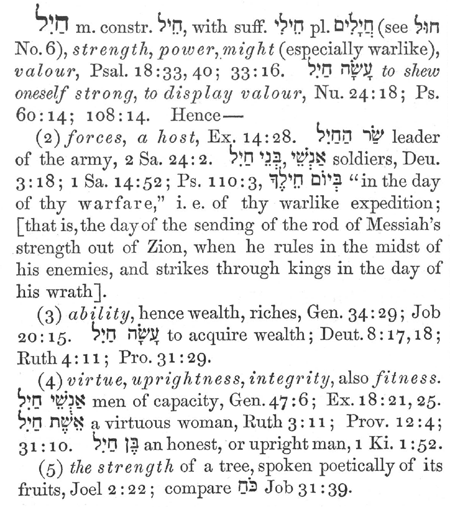
Chayil is defined by Thayer’s Lexicon (Strongs #2428) as:


Did you catch that? Chayil is used 243 times and translated:

  • army
  • man of valor
  • host
  • forces
  • valiant
  • strength
  • riches
  • wealth
  • power
  • substance
  • might
  • strong

Chayil is used 3 times specifically of a woman or women.
Ruth 3:11  – And now, my daughter, do not fear. I will do for you all that you ask, for all my fellow townsmen know that you are a worthy woman.
Proverbs 12:4 – An excellent wife is the crown of her husband, but she who brings shame is like rottenness in his bones.
Proverbs 31:10 – An excellent wife who can find? She is far more precious than jewels.

We have been through this before, but the Proverbs 31 list is not viewed in the Jewish tradition as a list of things all good wives (read “women of virtue”) must live up to. But rather it is a listing of examples of ways that women can show their Chayil. Just a bonus, if you read Proverbs 31 and compare it to the list above these are all different ways women can show valor or virtue. I will assert here again that there are as many ways to be an excellent wife as there are women. I would also assert that even these examples of virtue can have application to men as well. Could you not (gasp) reverse the genders in the Proverbs verses and still have truth? Let’s try it and see…

An excellent husband is the crown of his wife, but he who brings shame is like rottenness in her bones.
An excellent husband who can find? He is far more precious than jewels.

I know my excellent husband is like a crown to me. I am a very blessed woman. And I know plenty of women who can attest that a man who behaves shamefully is “like rottenness to her bones”.
Second one, once again, true. As the saying goes, “a good man is hard to find” and honey if you find one as good as mine you better hang on to him tight! He is more precious than a big ass engagement ring.

Okay, for grins, now let’s look at the word virtue in the new testament and see what it has to say. The word for virtue in the new testament is Dynamis. Dynamis is defined by Thayer’s as:


Dynamis is used 120 times and translated the following ways:

  • power
  • mighty work
  • strength
  • miracle
  • might
  • virtue
  • mighty

Dynamis is never used to exclusively describe men or women but rather God, Jesus, the Holy Spirit, the Kingdom, miracles and even the strength of sin.

Ok, enough background (sorry about the length of this post but I felt like proper background was needed), on to the article. Ms. Janovic lists what she considers to be “female virtues” at the beginning of her post: gentle and quiet spirit, modesty, chastity, faithfulness at home. She states that, “Scripture does not define virtues in terms of empty space; it is defined in terms of fruit.” First of all I feel compelled to point out that I am unable to find a verse in the Bible that defines virtue in terms of fruit. I am also unable to see where virtue is delineated along gender specific lines. I do see in Galatians where it lists the fruit of the spirit for both men and women.  I do see in scripture where it says that in Christ there is no male or female.

It would seem that the author subscribes to the gendered virtue model embraced by Rousseau. This model asserts that there are special virtues characteristic of each and arising out of their different basic natures. This model is extra biblical. P.J. Ivanhoe of the University of Michigan summed it up this way in his paper Women and Virtue,

In his work Emile, he describes the ideal education that a young man should receive, an education that will develop the set of virtues that are the full manifestation of his manly nature. In this same book, though not occupying as important a position, is a description of the proper education Emile’s sister, Sophie is to receive. It too is described in terms of developing virtues that fully manifest her basic nature. But while Emile’s virtues concern life in the public realm of a citizen, Sophie’s virtues concern life in the private realm of the home. According to Rousseau, women not only have special virtues that are theirs alone, they lack many virtues that are seen as exclusively male. And virtues that women are thought to lack are those required for public, political life – the realm of a great deal of power.

Ms. Janovic or other Christians I know who take her positions in this article might say they disagree with my characterization, however I think her post belies that assertion. First of all her use of the Fairie Queene as an illustration points directly to the division of the virtues into masculine and feminine. Chastity in this story is represented as a female Knight or female virtue. As she says, a “militant virtue” that “requires an active defense”.

What happens next and throughout the article I find patently offensive. She decides to use the imagery of men as dogs who simply go about “marking their territory”. She states:

“…if you have ever watched a nature film, or seen a dog on a walk, or really paid attention to life at all, you will have noticed a certain tendency among the male of the species. They mark their territory. They make a claim. They fight over the girl water buffaloes. Men do exactly the same thing, starting somewhere around the sixth grade. They like to impose on women around them in a way that builds their territory, or their prestige, or their ego.”

So guys, here it is, you are nothing but a beast who cannot be trusted to control himself when wanting to…
wait for it…
wait for it…
SIT NEXT TO A GIRL ON A BENCH IN A PUBLIC PLACE!
ASK A GIRL FOR A RIDE!
HAVE AN INSIDE JOKE WITH A FRIEND WHO HAPPENS TO BE A GIRL!
TEXTING HER TOO LATE

But it is ok, “it is not necessarily springing from any deep nefarious desires. Sometimes, it is just an accident. Sometimes it is a bad habit, or a different culture. Sometimes they aren’t actually paying attention when they impose. So don’t take this post as an accusation towards the men who impose on, or attempt to impose on you. These are all excellent opportunities for you to practice virtue.”
You see, you don’t even know you are being inappropriate, you are simply clueless. But that is ok too because it is all the woman’s responsibility to have a strong defense! She must not allow herself to “be imposed upon”. She should not “just let these things happen.” It is her fault if she stays on the bench when you sit down to chat. “Simply not resisting is how [she lets]a mark be made.”

Of course it is also her responsibility not to be shrill. According to the author, “Young women have a great deal of trouble with the fear of being shrill, and if that doesn’t scare them they probably are shrill.” So ladies, it is also your job not  to”overreact, but to be perfectly firm and cheerful. Someone unwelcome joins you on a bench? Unjoin him. Stand up. Walk away.”

The author also appears to think the women are clueless. She writes:

I know another problem for the unmarried women is that they might think that the young man, or young men, are all interested in them seriously. They feel like these things would not be happening in Christian circles if the men involved had no intentions. They would not be getting rides with me, walking me to my car, making a show of having inside jokes with me, or otherwise giving me attention if they were not actually interested in me.

Perhaps *gasp* the man and the woman are JUST FRIENDS! Perhaps they just want to get to know each other.

In the end her advice is this:

So if you are a young woman in this kind of situation, practice cheerful resistance. If the world of interaction between the sexes was a billiard table, be a bumper, not a pocket. Cheerfully, firmly, rudely  enforce your standards. You don’t owe him an explanation. Don’t get caught up in reasons you can’t give him a ride. Just say no. If he insists, pushes, tries harder, say, “Have a nice walk!”
Do not be afraid that this kind of defense will keep anyone from ever seriously being interested in you. If it is the right kind of man, this sort of behavior will bless him deeply.

Again guys, if this kind of behavior is off putting to you, if you think that when you sit down to chat with a girl on a bench and she gets up and walks away that she isn’t interested, you just aren’t the “right kind of man.”

The War on Women is NOT limited to Republicans

In the past week alone…

  • Hilary Rosen, a DNC consultant, has insulted stay at home mothers everywhere by saying women like Ann Romney have “never worked a day” in their lives.
  • We have learned that women in the Obama White House are earning 18% less than their male counterparts while President Obama travels around the country condemning this very problem.
  • The Republican Governor of Wisconsin repealed the state’s Equal Pay law. Republican state senator Glenn Grothman, who was an enthusiastic fan of repealing the law, actually said,
    • “You could argue that money is more important for men.” and “I think a guy in their first job, maybe because they expect to be a breadwinner someday, may be a little more money-conscious. To attribute everything to a so-called bias in the workplace is just not true.”
  • John Piper , influential pastor and author, posted, “When the Titanic sank 20% of the men and 74% of the women survived. That profound virtue was not nurtured by egalitarianism.”
  • Of the 740,000 jobs lost since president Obama took office, women accounted for 683,000 of those jobs.
  • Ashley Juddhad took to the internet to decry the morbid fascination people have with women’s appearances and the glee they seem to have in picking them apart (especially other women). She wrote,
    • Patriarchy is not men. Patriarchy is a system in which both women and men participate. It privileges, inter alia, the interests of boys and men over the bodily integrity, autonomy, and dignity of girls and women. It is subtle, insidious, and never more dangerous than when women passionately deny that they themselves are engaging in it. This abnormal obsession with women’s faces and bodies has become so normal that we (I include myself at times—I absolutely fall for it still) have internalized patriarchy almost seamlessly. We are unable at times to identify ourselves as our own denigrating abusers, or as abusing other girls and women.”

The “war on women” is not a war waged by Democrats vs. Republicans; Men vs. Women or Christian vs Atheist. It is not a war of gender or a war of politics. It is a war of ideas.  It must be turned into a war, not on women but a war on patriarchy. According to dictionary.com:

pa·tri·arch·y [pey-tree-ahr-kee]

noun, plural pa·tri·arch·ies.

1. a form of social organization in which the father is the supreme authority in the family, clan, or tribe and descent is reckoned in the male line, with the children belonging to the father’s clan or tribe.

2. a society, community, or country based on this social organization.

As Ashley Judd so eloquently said, “Patriarchy is not men. Patriarchy is a system in which both women and men participate.” I know plenty of men who, armed with love, education and justice wage war against patriarchy. I also know all too many women who defend patriarchy even when it means the subjugation and abuse of themselves, their daughters and other women.
I know many, many patriarchalists, some of whom believe with all their hearts that it is the answer to all of societies ills and for whom if they were honest would admit that they would prefer it if we could roll the clocks back to when women occupied the private sphere and men the public. I do not doubt their sincerity, I do however disagree with them vehemently on the roles of women in the family, in society, in the workplace, in politics, in church and in every arena.