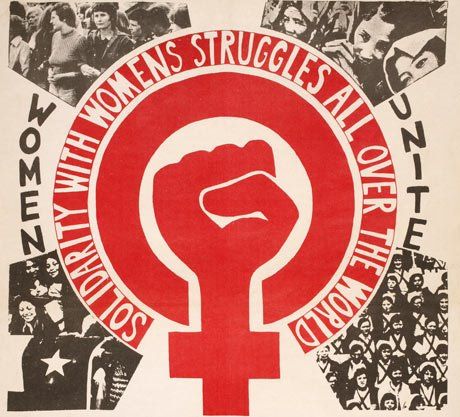
10 reasons why i’m an advocate for women’s liberation

I am out of town this week and am reblogging some favorite blogs from the last couple weeks while I spend time with my family at the happiest place on earth! See you on the other side.

Today’s installment comes to you from Kathy Escobar and was originally published 3/9/12. Enjoy.


yesterday was international women’s day.  and like usual, i’m always a little late to the party.  some people think i’m a broken record when it comes to women’s equality. i’m glad. i want to use my voice & hands & feet in any small ways i can to shift the tides of inequality & injustice that strip the dignity of women.

here’s why i’m pro-woman, pro-equality, pro-liberation-of-half-the-population:

1. i think Jesus was.  every interaction Jesus had with women was to set them free and lift their burdens of bondage.  and he said we were supposed to be like him.  i don’t know why the church built on his name has done the exact opposite; it still baffles me.

2. women’s wisdom will make the world better.   it’s said that the same way of thinking  that got us into our problems can’t get us out.  it’s time for some new minds & hearts to get in the mix so that more creative, peaceful, collaborative solutions can be considered in our families, cities, churches, ministries, and organizations.

3. it’s good for men, too.  i don’t want things to shift to women on top & men beneath them, either.  i’m pro-equality.  our freedom is tied up together. when we learn how to be equals, alongside one another as partners, brothers & sisters, teammates, and friends, it reflects God’s image in all kinds of beautiful ways.

4.  the church should be the leader of restoring dignity and equality, instead of dragging along behind.  so i may not be able to change the whole big church but i can play my part in cultivating equality & freedom in our little one.

5. others need us to fight for their freedom.  many can’t fight.  we have liberties others don’t.  our freedom is all tangled up together.  if we stay stuck, others stay stuck. if we get free, we can participate in setting others free, too.

6.  i have to look in my daughter’s eyes.  i have a responsibility to do whatever i can to make sure she has every opportunity she deserves inside & outside of the church.  i can’t tolerate someone telling her she is less because of her gender.

7.  i have to look in my son’s eyes, all 4 of them.  they deserve equal partners who will show up, and participate in relationship instead of remain silenced and diminished.  they deserve to be set free of the bondage of male stereotypes that limit and damage.

7.  yeah, the next generation needs us.  we can’t leave them hanging.  we have to keep paving the way, like the brave men & women before us, to make their path less & less bumpy.

8.  when we are silent, we stand on the side of the oppressor. it’s easier to play nice. it’s easier to follow the status quo.  it’s easier to stick with the crowd and keep supporting churches & the media & systems that strip dignity and freedom.  but when we do, we condone inequality and align with oppression.

9.  we must be the change we want to see.   i can’t sit around waiting for the church to change.  the kingdom isn’t going to drop out of the sky.  God uses people to change the world.

10.  freedom isn’t just a bigger cage.  liberation means full freedom in Christ, not just lesser-oppression.

happy international women’s day, one day late.

may we keep playing our part in liberation.

what about you?  what motivates you to keep advocating for freedom?

God and Homosexuality: Part 2 – Genesis 19

Genesis Chapter 19
The two angels came to Sodom in the evening, and Lot was sitting in the gate of Sodom. When Lot saw them, he rose to meet them and bowed himself with his face to the earthand said, “My lords, please turn aside to your servant’s house and spend the night and wash your feet. Then you may rise up early and go on your way.” They said, “No; we will spend the night in the town square.”But he pressed them strongly; so they turned aside to him and entered his house. And he made them a feast and baked unleavened bread, and they ate.

But before they lay down, the men of the city, the men of Sodom, both young and old, all the people to the last man, surrounded the house. And they called to Lot, “Where are the men who came to you tonight? Bring them out to us, that we may know them.” Lot went out to the men at the entrance, shut the door after him, and said, “I beg you, my brothers, do not act so wickedly. Behold, I have two daughters who have not known any man. Let me bring them out to you, and do to them as you please. Only do nothing to these men, for they have come under the shelter of my roof.” But they said, “Stand back!” And they said, “This fellow came to sojourn, and he has become the judge! Now we will deal worse with you than with them.” Then they pressed hard against the man Lot, and drew near to break the door down. But the men reached out their hands and brought Lot into the house with them and shut the door. And they struck with blindness the men who were at the entrance of the house, both small and great, so that they wore themselves out groping for the door.

This passage is one of the passages most often used to condemn homosexuality. If you read the passage through you will notice that it says “the men of Sodom, both young and old, all the people to the last man, surrounded the house.” Think about that, young and old to the last man. In San Francisco, almost 20% of the males over 15 years old gay. Are we to believe that 100% of the males over 15 years old in Sodom were gay? Hold that thought. Now think about this, Lot knows people in this crowd, he lives in this town. If these men (and boys) were all homosexuals why did Lot offer them his daughters? If you wanted to appease a crowd made up entirely of homosexual men would you try to appease them with the offer of sex with beautiful women? It doesn’t seem plausible.

Ok, so if the sin of Sodom is not homosexuality what is it?

Perhaps mob violence and the mistreatment and rape of those most vulnerable, in this case, strangers. I have been reading a book called “The Children are Free” by Rev. Jeff Miner and Rev. John Connoley. They use a rather brutal example to illustrate their point; in 1997 two white police officers used a broomstick to sodomize a Haitian immigrant named Abner Louima. While they perpetrated their violent act they yelled things like “We’re gonna teach you n****rs to respect police officers!” No one accused these officers of being homosexual. People understood that the assault was motivated by hate and fear. There is “no better way to demean and humiliate an enemy than to sexually violate them.”

Archeologists and historians teach us that it was common practice in the Near Eastern cultures of ancient times to use homosexual rape to humiliate and subdue conquered enemies.  This brutality was not motivated by homosexual desire but rather hate and the desire to humiliate.

This practice is still carried out among the prison population and even in the Abu Ghraib torture and humiliation of prisoners.

In The Children are Free the authors ask this simple question:

Suppose the two angels in the story had been women, but the story otherwise unfolded exactly the same: The men of Sodom clamored to have sex with the two female angels and God destroyed the city. Do you think anyone would conclude this story was a blanket condemnation of heterosexuality?  Of course not! Instead we would conclude (correctly) that the wickedness of Sodom was shown by their desire to sexually violate two strangers in their midst.

Good point isn’t it? We often say that rape isn’t about sex or sexual desire but power and violence. It doesn’t change whether the rape is homosexual or heterosexual in nature.

None of the almost 20 references to the city of Sodom in the scriptures mention homosexuality. In Ezekiel 16:49-50 it says, “Behold, this was the guilt of your sister Sodom: she and her daughters had pride, excess of food, and prosperous ease, but did not aid the poor and needy.They were haughty and did an abomination before me. So I removed them, when I saw it.” Why then do we assume Genesis 19 is about homosexuality? If it is about anything close, it could be called a condemnation of homosexual rape; however, I think the assertion that it is a condemnation of violence and mistreatment of those most vulnerable is most accurate.

Jesus also references Sodom and Gomorrah, where he warns those who do not receive them peacefully will be judged more harshly than those of Sodom and Gomorrah in Matthew 10:5-15.

These twelve Jesus sent out, instructing them, “Go nowhere among the Gentiles and enter no town of the Samaritans, but go rather to the lost sheep of the house of Israel. And proclaim as you go, saying, ‘The kingdom of heaven is at hand.’ Heal the sick, raise the dead, cleanse lepers, cast out demons. You received without paying; give without pay.  Acquire no gold or silver or copper for your belts, no bag for your journey, or two tunics or sandals or a staff, for the laborer deserves his food. And whatever town or village you enter, find out who is worthy in it and stay there until you depart. As you enter the house, greet it. And if the house is worthy, let your peace come upon it, but if it is not worthy, let your peace return to you. And if anyone will not receive you or listen to your words, shake off the dust from your feet when you leave that house or town. Truly, I say to you, it will be more bearable on the day of judgment for the land of Sodom and Gomorrah than for that town.

According to The Real Meaning of Sodomy by Nick Gier, Professor Emeritus, University of Idaho:

the Wisdom of Solomon says that they “refused to receive strangers when they came to them” (19:14). On the other hand, and early Christian book 1 Clement states that Lot was saved “because of his hospitality and piety” (11:11).

He also points out that it is significant that in the Leviticus passages that we covered last Monday, it does not mention the story of Sodom and Gomorrah.

Miner and Connoley also make this brilliant observation:

It is ironic that the story of Sodom is now used by Christians to justify the hatred toward another vulnerable group – gay people.

It is also interesting to note that several of the leading voices in theology on the anti-gay marriage side of the conversation agree that this passage should not be used as a proof text against consensual marital homosexual intercourse. I found this list on gaychristian101

Dr Richard Hayes is a well-known evangelical author. He wrote The Moral Vision Of The New Testament,in which he defends the anti-gay viewpoint. Yet in spite of the fact that he regards all gay relationships as sinful, Dr. Hayes admits that:

the Sodom story “is actually irrelevant to the topic.” [of homosexuality].

According to Dr. Hayes, the attempted gang rape in Genesis 19 shows the depravity of the Canaanite people who lived in the cities of the plain but:

“there is nothing in the passage pertinent to a judgment about the morality of consensual homosexual intercourse.”

(From Dr. Richard Hayes, in an article entitled, “Awaiting the Redemption of Our Bodies”).

Dr. Robert Gagnon, of Pittsburg Theological Seminaryand perhaps the most prominent anti-gay author today, admits the same thing in The Bible And Homosexual Practice

Although he too believes all gay relationships are sinful, on page 71 of his book, Dr. Gagnon tells us,

The Sodom story in Genesis 19 is usually viewed by modern Christians, as the classic Bible story about homosexuality. However, to the extent that the story does not deal directly with consensual homosexual relationships, it is not an “ideal” text to guide contemporary Christian sexual ethics.

Dr. Mark Allan Powell, of Trinity Lutheran Seminary, Columbus, OH expresses a similar view. Writing on page 23 of the book, Faithful Conversation – Christian Perspectives On Homosexuality,Dr. Powell says concerning the rape stories in Genesis 19 and Judges 19:

“Such stories reflect a mindset that regards the rape of men by other men as abhorrent, but with regard to current questions concerning homosexuality, these texts have little to offer. The stories speak only of the sin of homosexual rape and say nothing at all about consensual relations between persons of the same sex.”

Dr. William Brownlee, 1917-1983, of Claremont Graduate University, Claremont CA, an internationally renowned expert on the Hebrew language and the Dead Sea Scrollssaid about the Sodom story:

“The oppression of the stranger is the basic element of Genesis 19:1-9 [and] ‘sodomy’ in Genesis is basically oppression of the weak and helpless.”

Bob Davies, Former Executive Director of Exodus International, the largest Ex-Gay group in the world, in his book Coming Out Of Homosexuality, published in 1993.

“Pro-gay theologians are correct in saying that this passage [Genesis 19] does not provide a strong argument [for] prohibiting all homosexual acts.”

It is remarkable that one of the most theologically conservative national leaders of the largest Ex-Gay group on earth openly admits that the S@dom story does not provide a strong argument for prohibiting all homosexual acts.

Many scholars make the point that this is the first mention of any type of homosexuality in the scriptures and that it is featured in a violent and sin-filled story. While this is true, I believe that the foregoing analysis confirms one thing:  The story of Sodom and Gomorrah clearly has no significant bearing on whether or not God blesses consensual, marital, homosexual intercourse.

Related articles
Choice

there are harsh words enough in the world

to break a thousand hearts

enough stones to batter and crush

a million innocent bodies

enough misconceptions and judgments

to lock the door

and stay inside one’s narrow mind.


but I will hold my tongue

and breathe in kindness

until I can only speak love

I will seek to heal

the wounds I have inflicted


letting go of grudges

I will boldly face my fears
 
and act with intent
 
having left the world a better place
 
because I lived.

––Angela Beloian

God and Homosexuality: Part 1 – Lev 18:21 and 20:13

Leviticus 18:21
You shall not lie with a male as with a woman; it is an abomination.

Leviticus 20:13
If a man lies with a male as with a woman, both of them have committed an abomination; they shall surely be put to death; their blood is upon them.

First,  Scripture must be read it in light of its context and the culture in which it was written. When we look at the beginning of chapter 18:2-3 we read:

“Speak to the people of Israel and say to them, I am the Lord your God.You shall not do as they do in the land of Egypt, where you lived, and you shall not do as they do in the land of Canaan, to which I am bringing you. You shall not walk in their statutes.

The context of the chapter is that the Israelites are not to do as the Canaanites or Egyptians did when worshiping their gods. Chapter 20 is more specific saying not to take part in the rituals done in worship of a god named Molech. Both chapters set forth long lists of sexual practices common in the cultic worship of the cultures mentioned.The question then arises, what were the practices of the Canaanites and Egyptians? Biblical historians tell us that Canaanite’s worship often included sexual rituals. During the rituals, whole families, including husbands, wives, mothers, fathers, sons, daughters, cousins, aunts and uncles would engage in sexual activities, including some homosexual activities . There were also temple prostitutes involved in the worship of some of the gods. Having sexual intercourse with them was thought to bring you favor with the god or goddess of that particular temple.

Historians also tell us that homosexual relationships were untenable in such tribal cultures. Men and women were largely kept separated and men’s and women’s work clearly delineated. They simply would not have been familiar with a meaningful long term sexual relationship between members of the same sex. Wouldjesusdescriminate.org puts it this way:

It simply is not reasonable to believe the author of Leviticus intended to prohibit a form of homosexual relationship that did not exist at the time. When read in textual and historical context, the prohibitions in Leviticus 18 and 20 are clearly directed at homosexual temple prostitution, and that is how they should be applied.

Some people may object, saying, “But if you ignore the context and just read the words of Leviticus 18:22 and 20:13 in black and white, they appear to prohibit all sex between men, not just sex in pagan rituals.” But that is the whole point: The meaning of words depends on context. Remember, the words of 1 Corinthians 11 also appear to require long hair and head coverings for all women in all circumstances. But, because we have studied the context, we know that is not what was meant. A text taken out of context is pretext. Let’s apply the same common-sense rule here.

The Leviticus passages were clearly written in the context of pagan religious ritual. Since we are not bringing a question about the appropriateness of cultic sex practices for modern Christians, we can safely set aside these clobber passages.

The holiness codes had a purpose; to help keep Israel from falling into idol worship because of the land they came out of and the land they were entering. They were rules to keep them from falling into the ways of the people of those lands who worshiped false gods. These laws were not and are not universally applicable. Indeed, prior to these laws being given, God blessed several relationships forbidden in these two passages.

  1. Abraham and Sarah – an incestuous, brother-sister marriage.
  2. Amram and Jochebed – an incestuous, nephew-aunt marriage.
  3. Judah and Tamar – an incestuous, father in law-daughter in law marriage.
  4. Jacob, Leah, Rachel, Bilhah and Zilpah – a polygamous marriage.

These examples illustrate that the Levitcal laws had a beginning. These laws also had an end. Jesus. The only law that remains is the law of love. Love the Lord your God with all your heart, with all your soul, with all your mind and with all your strength. And love your neighbor as yourself. The law of love has overturned other things the church used to say were abominations: Interracial marriage, slavery and the subjugation of women, among others. The Levitical laws were given,

  1. to a specific people (Israel & resident aliens),
  2. in a specific location (Palestine),
  3. under specific rules (the Holiness Code),
  4. for a specific purpose (to bring them to Christ their Messiah),
  5. during a specific time period (1450 BC to AD 30).

If you intend to follow them, you must follow them all. Galations 5:1-3 says:

For freedom Christ has set us free; stand firm therefore, and do not submit again to a yoke of slavery. 2 Look: I, Paul, say to you that if you accept circumcision, Christ will be of no advantage to you. 3 I testify again to every man who accepts circumcision that he is obligated to keep the whole law.

There are many specific acts commanded in the Old Testament that we ignore and many that are prohibited that we enjoy. These are a few of my favorites noted in an open letter to Dr. Laura from several years back:

Dear Dr. Laura:

Thank you for doing so much to educate people regarding God’s Law. I have learned a great deal from your show, and try to share that knowledge with as many people as I can. When someone tries to defend the homosexual lifestyle, for example, I simply remind them that Leviticus 18:22 clearly states it to be an abomination. End of debate. I do need some advice from you, however, regarding some of the other specific laws and how to follow them:

When I burn a bull on the altar as a sacrifice, I know it creates a pleasing odor for the Lord – Lev.1:9. The problem is my neighbors. They claim the odor is not pleasing to them. Should I smite them?

I would like to sell my daughter into slavery, as sanctioned in Exodus 21:7. In this day and age, what do you think would be a fair price for her?

I know that I am allowed no contact with a woman while she is in her period of menstrual uncleanliness – Lev.15:19- 24. The problem is, how do I tell? I have tried asking, but most women take offense.

Lev. 25:44 states that I may indeed possess slaves, both male and female, provided they are purchased from neighboring nations. A friend of mine claims that this applies to Mexicans, but not Canadians. Can you clarify? Why can’t I own Canadians?

I have a neighbor who insists on working on the Sabbath. Exodus 35:2 clearly states he should be put to death. Am I morally obligated to kill him myself?

A friend of mine feels that even though eating shellfish is an abomination – Lev. 11:10, it is a lesser abomination than homosexuality. I don’t agree. Can you settle this?

Lev. 21:20 states that I may not approach the altar of God if I have a defect in my sight. I have to admit that I wear reading glasses. Does my vision have to be 20/20, or is there some wiggle room here?

Most of my male friends get their hair trimmed, including the hair around their temples, even though this is expressly forbidden by Lev. 19:27. How should they die?

I know from Lev. 11:6-8 that touching the skin of a dead pig makes me unclean, but may I still play football if I wear gloves?

My uncle has a farm. He violates Lev. 19:19 by planting two different crops in the same field, as does his wife by wearing garments made of two different kinds of thread (cotton/polyester blend). He also tends to curse and blaspheme a lot. Is it really necessary that we go to all the trouble of getting the whole town together to stone them? – Lev.24:10-16. Couldn’t we just burn them to death at a private family affair like we do with people who sleep with their in-laws? (Lev. 20:14)

I know you have studied these things extensively, so I am confident you can help. Thank you again for reminding us that God’s word is eternal and unchanging.

Your devoted fan,
Jim

Oh yes, don’t forget your tattoos.

God and Homosexuality: A Weekly Exploration

Last week my husband challenged me to explore this issue and share with him what I found. I decided I also wanted to share this journey with you. So today I am embarking on a new Monday series. For the next several weeks I will be exploring my understanding of the passages most often used to “prove” that homosexuality (or at the very least homosexual acts themselves) are sinful.

I feel it is important to start with an understanding of the way I read scripture and the way I don’t read scripture. When I pull up my Bible on my chosen Apple product, I no longer read it as a blue print, owner’s manual for life or constitution.  Instead, I try to read the Bible these days as a living breathing library of books. A library of books written by humans who were inspired by the Holy Spirit. Books not written in a vacuum, but written by a person with a specific set of talents, a specific vocabulary and a specific set of life experiences who lived in a specific time and in a specific culture. I no longer look at every word of the Bible as a telling of exactly what God wanted to happen; rather, I look at the Bible  as a collection of poems, prose, psalms and prophesies. Yes, some of them are history (they actually happened, some did not but are merely stories, and some we will never be sure). I believe that they all come together to tell an amazing story. It is a story of redemption, of love, of reconciliation. The books in the library we call the Bible tell the story not necessarily of what God wanted to happen but rather they tell the stories God wanted us to hear. Just like us, God tells us stories for a specific purpose. Sometimes to fill us with wonder and delight, sometimes to teach us a lesson, sometimes to stir our hearts against injustice, always to move us to action; always to move us toward love.

If you want to read a book that explains the way I look at the Bible you can check out The Blue Parakeet by Scot McKnight. I highly recommend it. In this book the author talks about how God spoke in Moses‘ days in Moses’ ways and in Paul’s days in Paul’s ways etc, etc.

I am looking forward to taking this journey with you. I hope that it is mutually beneficial for all of us.

What If God Was One of Us?

This week on American Idol Steven Tyler said something profound. The judges had just given Heejun Han the news that he would be part of this season’s top 24. Remarkably,Heejun had never sung in public before he auditioned for the show. After the tears and the hugs, Steven looks him in the eye and says, “You know, what is funny man is – that we are all bozos on the bus, until we find some way to express ourselves.” Steven goes on to say that some people express themselves through being a “lawyer or this or that” but … ” You and me, we take everything we have ever learned, and let it out (all of it) through our singing. You let it all out, we are touched by it.” Steven’s quote made me think of the above Joan Osbourne song (written by Eric Bazilian of The Hooters), One of Us.

If God had a name, what would it be
And would you call it to his face
If you were faced with him in all his glory
What would you ask if you had just one question

And yeah yeah God is great yeah yeah God is good
yeah yeah yeah yeah yeah

What if God was one of us
Just a slob like one of us
Just a stranger on the bus
Trying to make his way home

When this song first came out it was widely criticized. People said the word slob shouldn’t be used of God incarnate. I think they missed the point. You know what though? God is one of us! That is the whole point. He did become “just a slob like one of us.”  Webster says that slob can simply mean, “an ordinary person.” Philippians 2:5-11 says:

Have this mind among yourselves, which is yours in Christ Jesus, who, though he was in the form of God, did not count equality with God a thing to be grasped, but emptied himself, by taking the form of a servant, being born in the likeness of men. And being found in human form, he humbled himself by becoming obedient to the point of death, even death on a cross. Therefore God has highly exalted him and bestowed on him the name that is above every name, 10 so that at the name of Jesus every knee should bow, in heaven and on earth and under the earth, and every tongue confess that Jesus Christ is Lord, to the glory of God the Father.

He came here, that is the whole point. He didn’t stay away. He became a “slob like one of us” so that we could see that he loved us (John 3:16-17) and that he isn’t condemning us. He found a way to express that love, he found his voice and he poured all of himself into feeling what we feel, going where we go and suffering where we suffer. And guess what? He is STILL with us. He is the best part of humanity. He represents what it is to be fully human. His image is borne throughout the earth wherever people draw breath. And he reminds us that we are all along for the ride, “bozos on the bus” if you will, just trying to find our way to express our particular facet of His glorious image; To find our way home.

Have you ever felt like a bozo on the bus? I know I do, and I know Jesus did too. You know how I know? Because he experienced what it is to be one of us.

Recently, through this blog and through all of you, I feel like I have found my voice. Listen close, lean in and find yours. On your next spin on the bus of your life, stop and take a minute to truly hear the expression of God himself in the “bozo” in the seat next to you; Because you know what? That bozo bears the image of the God of the universe.

“Truly, I say to you, as you did it to one of the least of these my brothers, you did it to me.” Stop to hear the voices of the stranger (bozo) on the bus”   Matthew 25:40

recommended links:  http://www.relevantmagazine.com/god/church/features/28380-what-diversity-should-look-like

Conversation Over.

Yesterday I took a road trip to Waco with one of my favorite people to hear Rachel Held Evans speak at Baylor University‘s chapel service. Let’s just say, I went expecting awesomeness and I was not disappointed. We didn’t just get to hear Rachel speak at chapel, we also got to head to “The Bobo” (The Bobo Spiritual Life Center) and participate in a brown bag lunch Q & R session. When I walked into the room I noticed there was an open seat next to RHE and well, I’m not gonna lie, I totally almost ran to sit in it. There were several things I took away from my day at Baylor.

 1. Truett Seminary is emergent and egalitarian friendly! Who knew, right? Yesterday I met Ryan Richardson and his lovely wife Kristen. He is an Associate Chaplain and the Director of Worship at Baylor and she is an Associate Chaplain and Director for Formation and Baptist Student Ministries. He enthusiastically told me that Truett Seminary has been quite egalitarian for several years. Ryan is responsible for scheduling the chapel speakers and has brought in speakers like Brian McLaren, Tony Jones, Doug Pagitt and, of course, Rachel Held Evans (twice!).

 2. While Rachel was talking she said something that caught my ear. The Bible is a conversation starter not a conversation ender. We often make the Bible something it never says it is. We call it a guide book, a blue print, a manual and a constitution, when in reality it is none of these. I like McLaren’s picture of the Bible as a library.

 First, we must displace the habit of reading the Bible flatly. In a constitution, Article 5 has the same authority as Article 2. When the Bible is read this way, Jesus’ life and words are pressed down and flattened to the same level as those of Abraham, Moses, David, Isaiah, Paul, and Jude. In this approach, the words of and about Abraham, Moses, David, Isaiah, Jesus, Paul, and Jude are all “inspired Scripture,” so they all have the same value and authority. This elevation of the Bible above Christ is remarkably common in conservative churches, where it would never be stated so baldly, but is nevertheless rampant. In this light, it’s interesting to analyze the use of the words “Bible” and “biblical” in names and discourse. Think of the subtle (but potentially significant) difference between a Bible church and a community of disciples of Christ, or a Bible college and a discipleship college, or a Bible teacher and a disciple-maker. Think of the difference between arguing that an idea or behavior is biblical (meaning one can use constitutional reading techniques to justify it) and claiming that it is Christ-like. One might argue (by avoiding everything we’re recommending here!) that it is biblical to commit genocide by quoting Deuteronomy 7, but one could never claim it is Christ-like.

When we view the Bible as a library, we are free to place more importance on the words of Jesus over the words of Paul or the words about genocide. Jesus is -and was – God made flesh. He is the perfect representation of all we are to strive to become. We are encouraged to have the mind of Christ, not the mind of Moses or even of Paul. Rachel talked about this again in her post yesterday about Christian Smith’s book, The Bible Made Impossible. Please forgive the quote within a quote but I thought it was a good insight.

In The Bible Made Impossible, Smith tackles the problem of  “biblicism,” which he defines as “a theory about the Bible that emphasizes together its exclusive authority, infallibility, perspicuity, self-sufficiency, internal consistency, self-evident meaning, and universal applicability.”

Biblicism falls apart, Smith says, because of the “the problem of pervasive interpretive pluralism,” for “even among presumably well-intentioned readers—including many evangelical biblicists—the Bible, after their very best efforts to understand it, says and teaches very different things about most significant topics…It becomes beside the point to assert a text to be solely authoritative or inerrant, for instance, when, lo and behold, it gives rise to a host of many divergent teachings on important matters.”

3. Another point she made that I loved was that the Bible does not layout one path to biblical womanhood (or manhood for that manner). She pointed out that often today, the 50s ideal of June Cleaver is lifted up as the model of biblical womanhood. In reality, the world and time in which the Bible was written had never seen the likes of June Cleaver. In fact, you can search high and low in scripture and you will not find a single woman who fits that model. The Bible is full of woman and about the only thing that is for sure is that every one of them is unique and different and has her own gifts just like all of us. I don’t know about you, but I am so comforted that God doesn’t choose to give women just one blueprint of what biblical womanhood is all about, but instead provides many vastly different examples of what it means to be an Aishat Chayil! Woman of Valor!!

4. I was also struck by the story Rachel told about the ceremony she and her friend had honoring the women of the Bible who were victims of violence perpetrated in the name of God. She talked about how we need to remember them, how we need to honor them by telling their stories. It is easy to read over the difficult passages of the Bible and forget that these were real people with real lives who were made to suffer in the name of God. I don’t think these stories are included in our library we call the Bible because it is the way things were supposed to be.  Rather, these stories serve as examples of what horrible things can be done in the name of God. I think these stories are warnings. God’s way of saying, this isn’t me, this isn’t what I want…stop it. “I desire mercy not sacrifice.” Ultimately, God sends his son because the message just doesn’t seem to be coming through. Jesus comes to love, to sacrifice, to ransom the captives and set at liberty those who are being oppressed. He comes to save not to condemn. He comes to forgive sin not to throw a stone.

There were many, many more things that I took away from my trip and hopefully I will get a chance to share more of them later. Suffice it to say that if Rachel is coming to somewhere close to you, I encourage you to take a little road trip to see her. Conversation over.

Lecrae, 116 Clique and John Piper – 100% Masculinity

“Let me take you back to the tree in Eden
If you read it you’ll see that Eve was deceived
But Adam’s the one who let her eat
Instead of leading
No we ain’t leading
We Bump That
Basically little boys with muscles and our mustache
To femininity we need a remedy
The God-Man 100% masculinity.”

The above quote is from a new song called, “Man Up Anthem” by 116 Clique featuring Lecrae from Lecrae’s record label, Reach Records. It is a sentiment found all too often in Christendom and one that is slowly being chipped away at by people like Lindsey Haskins and blogs like Jesus Creed. In today’s post on the Jesus Creed blog, Ms. Haskins shows how in spite of Pipers assertion that,”for the maximum flourishing of both men and women” the church should and must have a “masculine feel”, nothing could be further from the truth.

Piper says, “the Father and the Son create man and woman in His image and give them the name man, the name of the male.”
Man Up Anthem says, “Let me take you back to the tree in Eden, if you read it you’ll see that eve was deceived but Adam is the one who let it in.”

Here are some thoughts on women from well respected church fathers:

Chrysostom, speaking of Eve in the garden – “…the woman taught once for all and upset everything…for the female sex is weak and vain, and here this is said of the whole sex”

Tertullian – women  are the “ianua diabolic” or “the gate of the devil” (On Female Dress, 1.1).

St. Clement of Alexandria – “Every woman should be filled with shame by the thought that she is a woman…the consciousness of their own nature must evoke feelings of shame.

St Thomas Aquinas –  “Good order would have been wanting in the human family if some were not governed by others wiser than themselves. So by such a kind of subjection woman is naturally subject to man, because in men the discretion of reason predominates.”

I could go on and on.

Piper says, “Now, from all of that I conclude that God has given Christianity a masculine feel. And being God, a God of love, He has done that for our maximum flourishing both male and female.”
Man Up Anthem says, “The femininity, we need a remedy, the God-Man, a 100 percent (strength) masculinity.”

Clearly when one looks at the history of women in the church it has NOT been “for the maximum flourishing of both men and women”. In fact, if a woman did manage to slip through the cracks and overcome societal efforts to deprive her of education, equality and opportunity, she was met with surprise and astonishment. They were so opposed to the notion that women as a gender were capable of such things that they would de-feminize her and assign manhood to her instead of her God given femaleness. They said things like:

Clement of Alexandria – “Women must seek wisdom, like men, even if men are superior and have first place in every field, at least if they are not effeminate”

Paulinus of Nola – “What a woman she is, if one can call so manly a Christian a woman!”

Palladius – she was “not a woman but a manly creature: a man in everything but body”

Melania the Younger – because of her great piety or “manly deeds” was claimed to be “like a man” by her male admirers since “she had surpassed the limits of her sex and taken on a mentality that was manly, or rather angelic”

Haskins also points out that this way of thinking whether from Tertullian, Clement of Alexandria or John Piper is damaging to God’s daughters. How could it not be? She asserts:

When holiness is equated to masculinity, it is rather difficult to side-step notions of femaleness—or “femininity”—as ontological inferiority.  If by nature weaker physically, emotionally and spiritually as compared to men, the logical—and lived—conclusion against all lip service to the contrary has been that women do not share equally with men in the imago dei.

The line from Haskins that reminded me of the Lecrae song was this, “The Son of God came into the world to be a man” [which] seems to infer—especially in light of the greater arc of Piper’s vision—that it was maleness which God redeemed, not humanity. The lyrics say, “The femininity, we need a remedy, the God-Man, a 100 percent (strength) masculinity”. I assert that it is not masculinity that saved us from femininity; rather, that love compelled Christ to come and save us from fear, hate and darkness; that love compelled Christ to sacrifice all to save us from ourselves, our sin and our selfishness. He came to restore our relationship with the one who made us BOTH, male and female, in his image. TOGETHER the two halves of humanity reflect his glory.

I agree with Haskins when she says:

What the church needs now is not by any means a “masculine feel.”  The church has had this broken and un-balanced “feel” for millennia and far from producing a “flourishing [for] both men and women” it has too often been complicit in a systematic de-humanization of half its constituency.  When masculinity becomes the virtue par execellence the value of what it means to be a woman or “feminine” is mortally undercut.  What the church desperately needs now is a prophetic voice reminding us to value both men and women as equally and wholly made in the imago dei.

Ms. Haskins, may I humbly suggest that you are one such prophet.

Dear John Piper, Would You Like a Ride on my Toboggan?


Dear John Piper,

I would like to thank you for your recent comments about the masculinity of the church, indeed of all creation. You have succeeded in drawing a bright line that everyone can see. It is the defining line of what complementarians actually believe. Thank you for being honest and just laying it all out there. Thank you for not mincing words or hiding behind things like “everyone is equal in God’s eyes, we just have different roles.” I really appreciate that too. Now people can see the true choice between your view and mine.

John, as a gesture of my gratitude I would like to offer you a ride on my toboggan. Rachel and Susan and my husband Kent, most of the people from my church, Wade Burleson & Jesus are already on board and I have seen lots of other folks here on the slippery slope. But don’t worry, there is still room for you. I think maybe you are scared of what will happen if you go over the edge. I promise you it will take your breath away and at moments you may wonder what is happening but once you have taken a ride down the slippery slope you will find that it isn’t as scary or as slippery as you might think. (Just curious, what exactly is the fear if we afford women true equality in church and life? Sometimes I think people are afraid that elders meetings will turn into slumber parties where we all do each others hair and nails if women are included).

Heck you might enjoy it. You might even decide to take a run at a couple other slippery slopes while you are at it. How about homosexual hill? What will happen if we allow homosexuals to get married and come to our gatherings and worship Jesus with us? Are we afraid that our own children might become (I don’t think it is something you become btw) gay? Some of them already are; they are just scared to say so because they have been taught that the love of Jesus isn’t for homosexuals. Jesus never said that. He loves with no “unless”.

How about evolution incline? What will happen if we as Christians embrace or even entertain the scientific evidence for evolution? Are we afraid that God won’t be God anymore or are we just afraid that we might be wrong about him and he isn’t just like us? If God is God he has nothing to fear of science; he created science. All truth is God’s truth.

Pull on your mittens John, I can promise you a wild ride. I will be waiting for you at the top of the next hill.

m

Lovlies,

The video at the beginning of this post is shocking, yes? It is one of the first things I thought of last night when I heard about of John Piper’s remarks. The church in large numbers has been on the wrong side of history on several occasions including women’s suffrage, slavery & segregation. I am afraid that Piper is on the wrong side of history this time.

After reading the article last night on The Christian Post, I wondered how exactly Piper defines the terms masculine and feminine. Luckily for me I found this video. In it Piper uses a graphic that states the definitions he uses:

The Meaning of masculinity
At the heart of mature masculinity is a sense of benevolent responsibility to lead, provide for and protect women in ways appropriate to a man’s differing relationships.

The meaning of Mature Femininity
At the heart of mature femininity is a freeing disposition to affirm, receive and nurture strength and leadership from worthy men in ways appropriate to a woman’s differing realtionships.

Don’t you see women, this is a doctrine of freedom for you? You (as he goes on to say in the video) have the freedom to choose the man who will lead you. Once again, I am thankful for the bright line he has drawn. It forces you to think about what you really believe on this issue. It is one of the big three facing the church today. What about women? What about homosexuals? and What about evolution? Alas, we are only here to address the one slippery slope today. Here is the thing, we are all to mutually submit to one another. We all, according to our gifting, lead, provide for and protect one another. We all have the responsibility to affirm, receive and nurture each other. This post by Sarah Bessey is a great picture of this type of marriage relationship. But it isn’t just in marriage that mutual submission should take place. It is everywhere; at home, in the church, with your friends or at work. Everywhere with everyone. Can you imagine a world where we actually lived like this?

Piper seems to ignore many verses in scripture in his misogynistic interpretation of the scriptures in the article. These are just a few.

Galatians 3:27-28
27 For as many of you as were baptized into Christ have put on Christ. 28 There is neither Jew nor Greek, there is neither slave nor free, there is no male and female, for you are all one in Christ Jesus.

Unless…oh wait, there is no unless.

Genesis 1:27-28
27 So God created man in his own image, in the image of God he created him; male and female he created them. 28 And God blessed them. And God said to them, “Be fruitful and multiply and fill the earth and subdue it, and have dominion over the fish of the sea and over the birds of the heavens and over every living thing that moves on the earth.” (notice he created them in his own image, he gave dominion to them).

Wade Burleson had an excellent post today where he stated:

The male and the female were both designed to rule. Men and women are created by God in His image as co-regents of the world He created. Any system, any society, any organization that places one gender as an authority over the other, whether it be patriarchal or matriarchal in nature, is a direct violation of the command and design of the Creator God. Why can women rule in God’s creation? Why can women lead in God’s creation? Why can women be equal to men in God’s creation? Women are created in the image of God, just like men, and when the omnipotent, sovereign and invisible Creator God determined to create man in His image, He created a male and a female, reflecting the very nature of God Himself. This is why there is nothing wrong with considering God as both Father and Mother, as the invisible and all-powerful Ruler of the universe who reflects Himself in both males and females–God is Spirit and the perfections of each gender are seen in God.

AMEN! Thank you Wade. I love fellow toboggan riders.

Isaiah 46:3
“Listen to me, O house of Jacob, all the remnant of the house of Israel, who have been borne by me from before your birth, carried from the womb;
John Calvin wrote (btw, John Piper is a self proclaimed 7 point Calvinist),

God has manifested himself to be both Father and Mother so that we might be more aware of God’s constant presence and willingness to assist us.

Isaiah 49:15
15 “Can a woman forget her nursing child, that she should have no compassion on the son of her womb? Even these may forget, yet I will not forget you.
Calvin’s commentary on this verse states:

God did not satisfy himself with proposing the example of a father, but in order to express his very strong affection, he chose to liken himself to a mother, and calls His people not merely children, but the fruit of the womb, towards which there is usually a warmer affection.

Matthew 20:25-28
25 But Jesus called them to him and said, “You know that the rulers of the Gentiles lord it over them, and their great ones exercise authority over them. 26 It shall not be so among you. But whoever would be great among you must be your servant, 27 and whoever would be first among you must be your slave, 28 even as the Son of Man came not to be served but to serve, and to give his life as a ransom for many.”

I will leave it to you. But remember the words of the great abolitionist, Sir William Wilberforce, when you are ready to throw in the towel and think that we cannot succeed in changing the status quo,

Accustom yourself to look first to the dreadful consequences of failure; then fix your eye on the glorious prize which is before you; and when your strength begins to fail, and your spirits are well nigh exhausted, let the animating view rekindle your resolution, and call forth in renewed vigour the fainting energies of your soul.

Let Me Help You With Your Luggage or Coming Out of the Church Closet.

Let me help you with your luggage. I want to hear all about your trip.

I want to hear your stories; Stories of the beautiful and the hurtful; Stories of the pain you couldn’t bear and those who helped you bear it . I need to share your journey from where you have been to where you are going. I want, no, I need to help you carry your luggage and lighten your load. I am anxious to hear the stories of your travels and see the pictures of where you have stopped along the way. I want to know the life lessons you have learned and the ones you are still struggling with. I believe it is through the telling and retelling of the stories of what God is doing and how he is traveling with us, that change people. Through stories our eyes are opened and we understand things that were just abstract to us before. And you, you my lovelies, are not abstract. You are very very real aren’t you? You are people. You are children of God. You are loved and valued beyond what you can imagine. First by God and then by me. So I would like to ask you, would you share yourself with me?

I would like to start a weekly feature where I share more stories like the one in my recent post, Pray Away the Gay?  I would love to hear your “Coming Out of the Church Closet” story if you are part of the GLBT community or have a family member who is gay then I would like to share it with our friends here.  You may share your stories with or without real names (please make sure you have people’s permission if you use their names). Your choice. I hope you will decide to do this. The church needs to hear your stories because they are our own stories. You are a part of us after all, whether people want to admit it or not. Jesus died for us all and he came to save the world not to condemn it (John 3:17). You can send me your stories for review at Michelle@novitaschurch.com.

Thank you for sharing yourselves with me.

m